Did you know that the ionosphere high in the Earth’s atmosphere has a significant impact on our communications systems, satellites, and even the ozone layer? Well, a recent simulation study led by geophysicist Yuto Katoh at Tohoku University, published in the journal Earth, Planets and Space, has shed new light on the activity of high energy electrons in the ionosphere.
“Our findings reveal the unexpected role of the Earth’s geomagnetic field in protecting the atmosphere from high energy electrons,” says Katoh.
The ionosphere, located between roughly 60 and more than 600 kilometers above the Earth’s surface, is filled with electrically charged particles generated by the interaction of the atmosphere with radiation from the sun. In the polar regions of the ionosphere, there is a constant influx of energetic electrons known as electron precipitation. These relativistic electrons, moving at close to the speed of light, collide with gas molecules and contribute to various phenomena in the ionosphere, including beautiful auroral displays. The geomagnetic field plays a crucial role in influencing these processes.
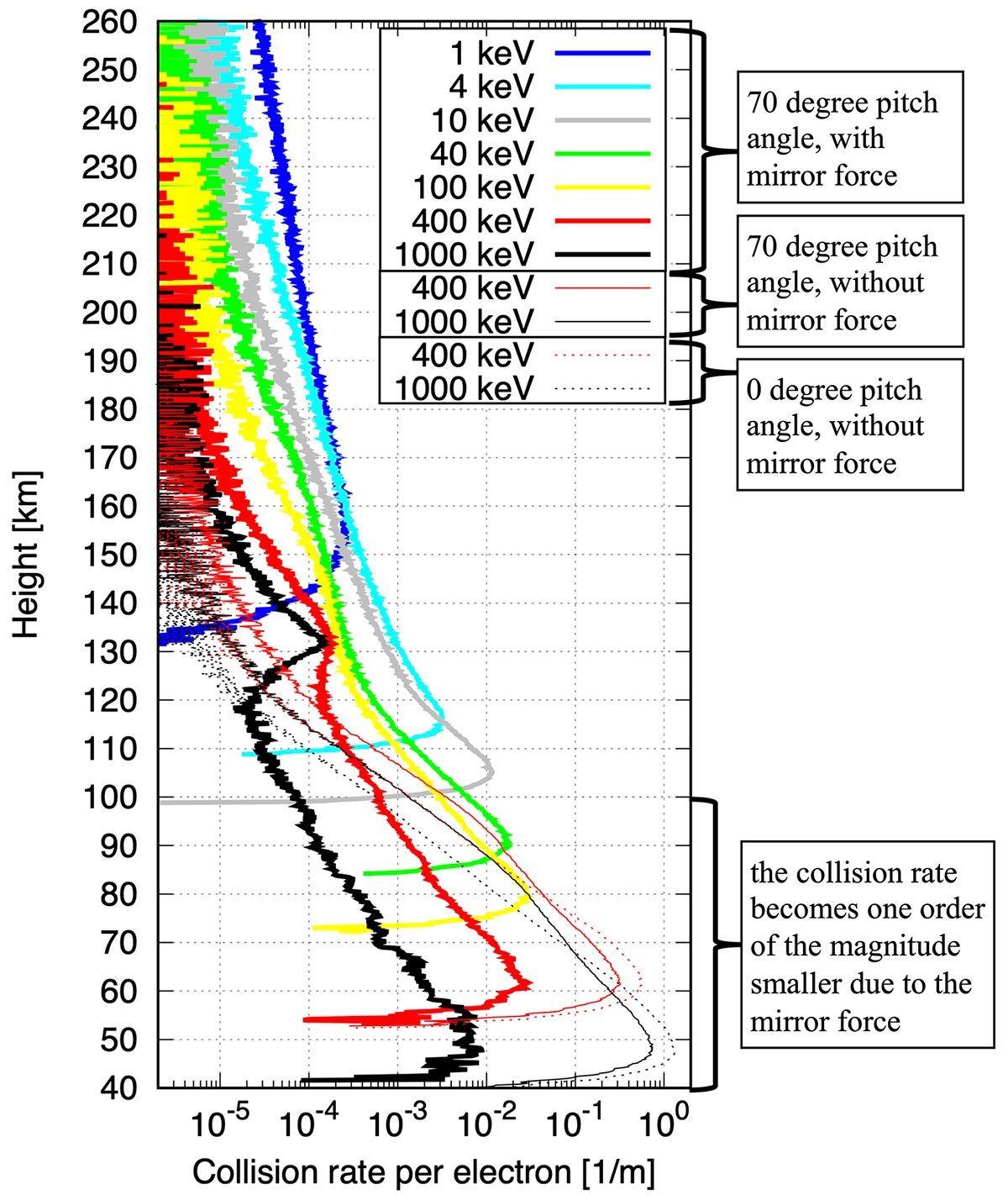
To study the effects of the geomagnetic field on electron precipitation, the Tohoku team, along with colleagues in Germany and other institutions in Japan, developed a sophisticated software code. Their simulations revealed the impact of a relatively unstudied “mirror force” on the electron precipitation. This force, caused by the magnetic force acting on charged particles under the influence of the geomagnetic field, causes relativistic electrons to bounce back upwards, colliding with other charged particles higher in the ionosphere than previously thought.
One significant implication of this research is the role of electron precipitation in chemical reactions related to variations in ozone levels. Katoh explains, “Precipitating electrons that manage to pass through the mirror force can reach the middle and lower atmosphere, contributing to decreased ozone levels at the poles caused by atmospheric pollution. This reduction in ozone levels compromises the protection it provides against ultraviolet radiation for living organisms.”
Katoh emphasizes the theoretical breakthrough of this study, highlighting the surprising significance of the geomagnetic field and the mirror force in safeguarding the lower atmosphere from the effects of electron precipitation activities by keeping them at a distance.
“We are now embarking on a project to combine our simulation studies with real observations of the polar ionosphere, aiming to deepen our understanding of these crucial geophysical processes,” says Katoh.