Did you know that conductive polymers are often called synthetic metals because of their electrical conductivity? These polymers, known as conjugated polymers, are now being developed as new optical materials to replace inorganic materials. Not only do they conduct electricity, but they also exhibit luminescence, rotation, and light absorption.
Conjugated polymers with helically grown molecules can emit circularly polarized light and rotate light. Researchers are also exploring the magnetic properties of synthetic metals.
In a groundbreaking study published in Materials Advances, scientists synthesized polythiophenes with stable radicals on the side chains. These radicals serve as a source of magnetism and were incorporated into liquid crystals with chiral and helical structures.
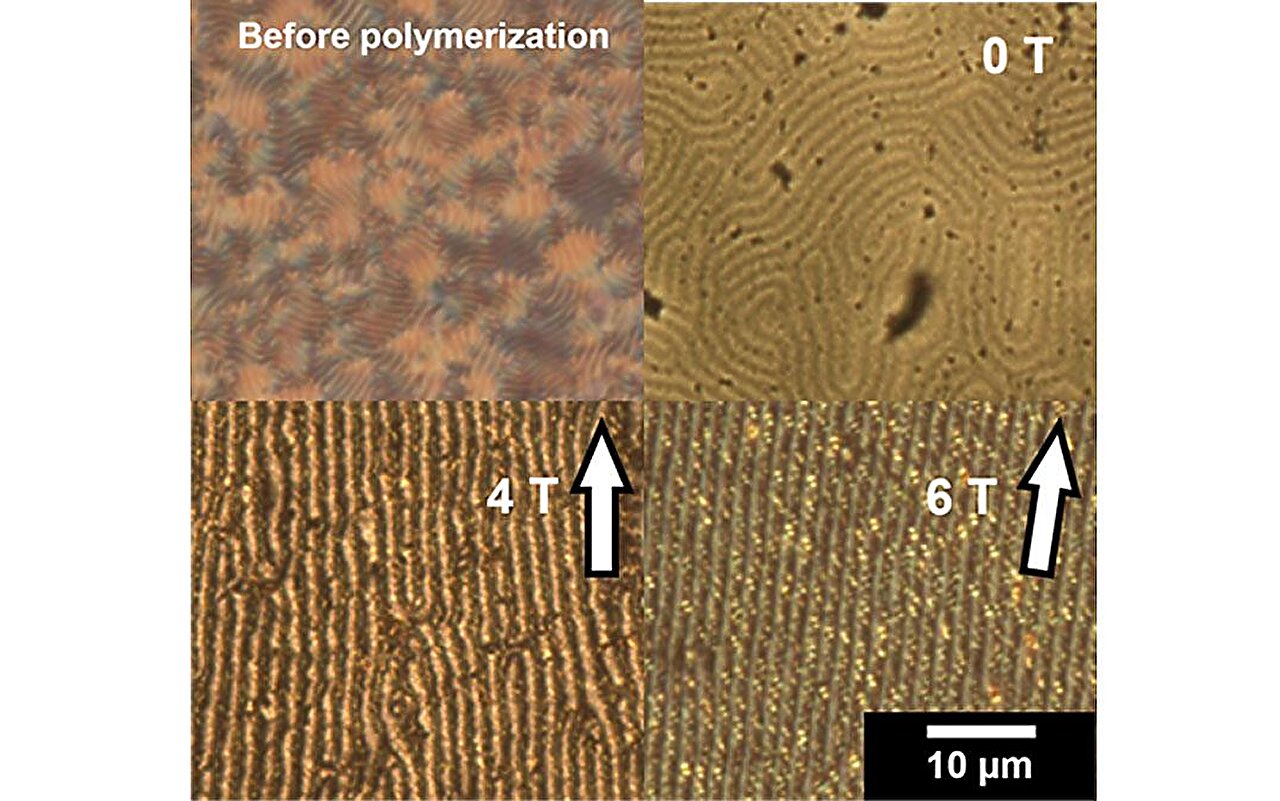
The researchers discovered that the polymer retained the helical structure of the liquid crystal, with the radicals arranged in a helical shape. When the polymer was aligned using a superconducting magnet, it formed stripe structures similar to magnetic domains found in inorganic compounds.
This study marks the first synthesis of an organic polymer that can be aligned either helically or as magnetic domain-like stripes, depending on the synthesis conditions.
Magnetic phenomena are not only observed in inorganic materials but also in living organisms. For example, heartbeats and brain waves exhibit magnetic properties, and certain animals like pigeons and eels have sensors in their brains that detect magnetism. Since these phenomena are related to proteins with helical structures, this research could provide insights into the magnetism of inorganic materials derived from organic polymers and shed light on magnetic phenomena in living organisms.