For centuries, humans have been captivated by the mesmerizing beauty and unique properties of glass. From jewelry to containers and tools, this material has been used to create remarkable creations. However, the science behind glass formation is far from simple.
In a groundbreaking study published in Nature Communications, researchers from the Institute of Industrial Science at The University of Tokyo used numerical simulations to unravel the mysteries of glass formation. They discovered a new type of compositional ordering that involves patterns with small and large particles, which could impact the formation and structure of glass.
Unlike a flowing liquid or a structured crystalline solid, glass exists in a “metastable supercooled state.” This means that the liquid is rapidly cooled, preventing its particles from rearranging themselves and resulting in a disordered configuration.
However, the conditions necessary for the ideal formation of glass, without crystallization or phase separation, are still not fully understood. A deeper understanding is crucial for improving the physical properties of glassy materials, including smart device screens.
In recent years, scientists have developed a specialized model liquid that can achieve a deeply supercooled state, allowing for the study of its properties without interference. This model liquid has gained popularity in the scientific community, and the researchers used computer simulations to gain insights into its characteristics.
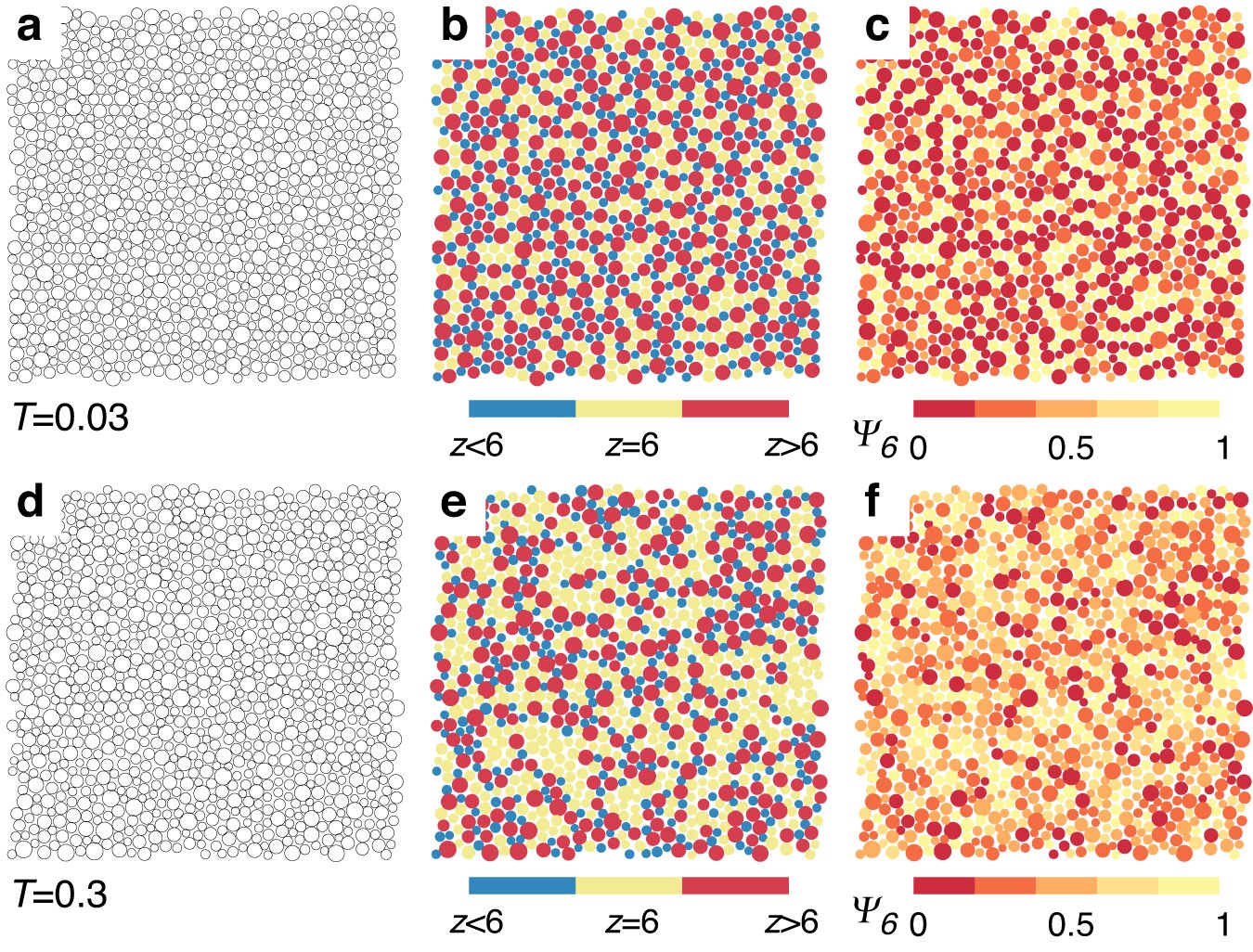
To their surprise, the simulations revealed unconventional structural arrangements, such as connections between small and large particles, as well as patches formed by medium-sized particles. These arrangements had a significant impact on the material’s behavior during the cooling process. By tracking the “coordination number” of the particles, which measures their number of neighbors, the researchers identified novel patterns of small and large particles.
“We observed an unusual network-like structure that hasn’t been reported before. We named this unconventional pattern ‘exotic compositional order’,” says lead author Hua Tong. This exotic compositional ordering was found to have a unique influence on the material’s structural relaxation dynamics. “Our findings raise doubts about whether this model liquid can truly be considered an ideal glass-forming liquid,” explains senior author Hajime Tanaka.
The discoveries made in this study have the potential to contribute to the development of an ideal model liquid specifically designed to explore the fundamental nature of glass transition.