Get ready for an exciting new project from NASA! Deep Space Optical Communications (DSOC) is set to launch this fall and aims to revolutionize data transmission in space. By using lasers instead of radio frequency systems, DSOC could significantly speed up communication and pave the way for broadband connections that will support NASA’s mission to send astronauts to Mars.
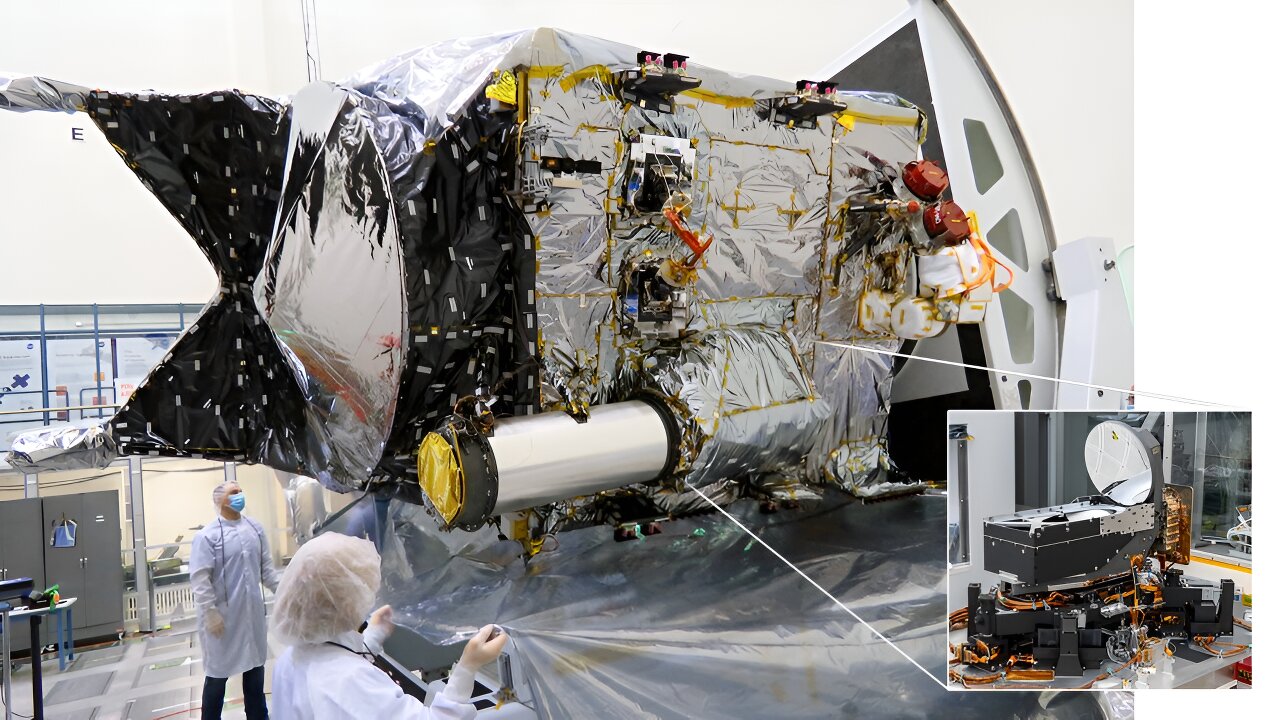
But how does DSOC work? The project will use a near-infrared laser transceiver to send and receive data. During NASA’s Psyche mission to a metal-rich asteroid, the transceiver will communicate with ground stations in Southern California. This will allow scientists to test sensitive detectors, powerful laser transmitters, and innovative signal decoding methods for deep space communication.
Why is NASA focusing on laser communication? Well, while both radio waves and near-infrared laser communication use electromagnetic waves to transmit data, lasers can pack data into much tighter waves. This means that ground stations can receive more data at once, surpassing the bandwidth of traditional radio systems.
“DSOC was designed to demonstrate 10 to 100 times the data-return capacity of state-of-the-art radio systems used in space today,” said Abi Biswas, DSOC’s project technologist at NASA’s Jet Propulsion Laboratory. “Deep space presents new challenges, but DSOC is a crucial step towards improving communication technologies for future space missions.”
With more missions heading to deep space than ever before, the need for advanced communication technologies is greater than ever. DSOC and similar experiments will play a vital role in helping NASA develop technologies that can be used by spacecraft and ground systems in the future.
“DSOC represents the next phase of NASA’s plans for developing revolutionary improved communications technologies that have the capability to increase data transmissions from space—which is critical for the agency’s future ambitions,” said Trudy Kortes, director of the Technology Demonstrations Missions program at NASA Headquarters.
Groundbreaking technologies
The DSOC transceiver on the Psyche mission features several groundbreaking technologies. It includes a never-before-flown photon-counting camera attached to a telescope, which will autonomously scan for and lock onto the high-power near-infrared laser uplink. This laser uplink will also demonstrate the ability to send commands to the transceiver.
“The powerful uplink laser is a critical part of this tech demo for higher rates to spacecraft, and upgrades to our ground systems will enable optical communications for future deep space missions,” said Jason Mitchell, program executive for NASA’s Space Communications and Navigation program.
To receive the high-rate downlink laser from the DSOC transceiver, the Hale Telescope at Caltech’s Palomar Observatory has been fitted with a novel superconducting nanowire single photon detector assembly. This assembly can detect and record the arrival time of a single incident laser photon. The laser light must travel over 200 million miles before the faint signals can be detected and processed.
“Every component of DSOC exhibits new technology, from the high-power uplink lasers to the pointing system on the transceiver’s telescope and down to the exquisitely sensitive detectors that can count the single photons as they arrive,” said JPL’s Bill Klipstein, the DSOC project manager.
The distances involved in deep space communication pose another challenge for the tech demo. As the spacecraft moves farther away, the lag time for laser photons to reach their destination can be up to tens of minutes. The team will need to compensate for this lag by constantly adjusting the laser’s position and accounting for the changing positions of Earth and the spacecraft.
“Pointing the laser and locking on over millions of miles while dealing with the relative motion of Earth and Psyche poses an exciting challenge for our project,” said Biswas.