Get ready for groundbreaking advancements in thermochemical energy storage and other technologies! Researchers from Japan have just cracked the code on ion hydration, a crucial principle for optimal performance in these technologies. This breakthrough will revolutionize electrolyte design and open up a world of possibilities in chemistry, biology, and materials science.
In a groundbreaking study published in Nature Communications, researchers from the Institute of Industrial Science at The University of Tokyo have unveiled the secrets of ion hydration in water-based solutions. By understanding how ion hydration works and how it can be stabilized, they have paved the way for advancements in various fields.
Traditionally, scientists categorized ions as either structure-forming or structure-breaking based on their impact on water molecule networks. However, recent evidence suggests that this explanation is too simplistic. To delve deeper into ion hydration, the researchers focused on the ionic field and its relationship with the ion-water distance and charge.
Previous studies mainly examined naturally occurring ions with discrete sizes and charges. To gain a comprehensive understanding, the researchers expanded their investigations to include synthetic or unnatural ions with continuous size and charge. Through computational simulations, they were able to uncover new insights into ion hydration.
“Our simulations shed light on the interactions between pseudo-main-group cations and water, specifically the Coulomb and Van der Waals forces,” explains Rui Shi, lead author of the study. “We discovered previously unknown details about the ion hydration shell and its impact on water dynamics.”
The researchers’ key finding is that ions with lower charge density interact with more water molecules, forming weaker bonds between them. This phenomenon applies to all ions, regardless of their specific properties. The distance at which the ion-water interaction matches the strength of water-water hydrogen bonding determines the acceleration or deceleration of water dynamics around the ion.
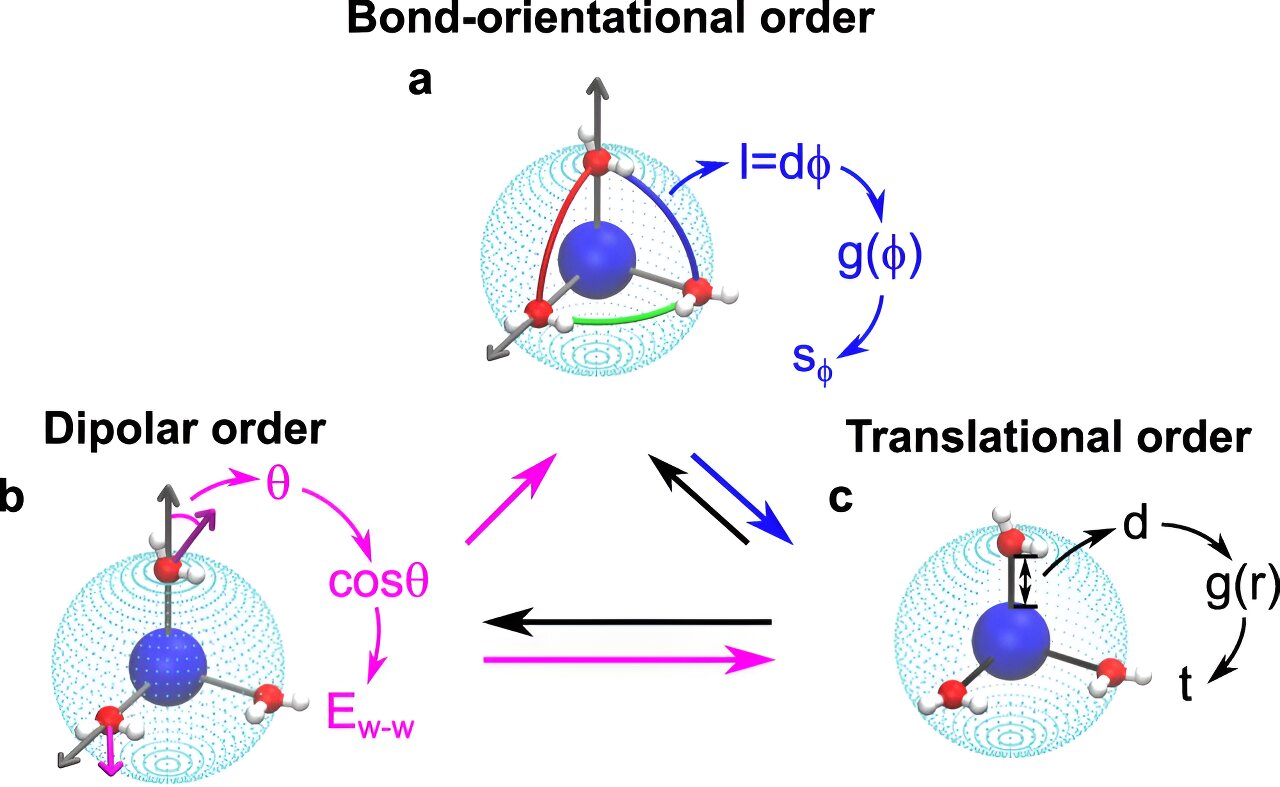
“We also uncovered the reason behind the 11 orders of magnitude difference in hydration water residence times,” says Hajime Tanaka, senior author of the study. “By manipulating the size and charge of ions, we can induce the bond-orientational order of hydrated water molecules and stabilize the hydration shell. This reveals a new mechanism for highly stable hydration of certain ions.”
The implications of this research are far-reaching, spanning across chemistry, biology, materials science, and various industries. From energy storage using salt hydrates to purification technologies for RNA-based medical therapeutics, a deeper understanding of ion hydration in water-based media will drive innovation and progress.