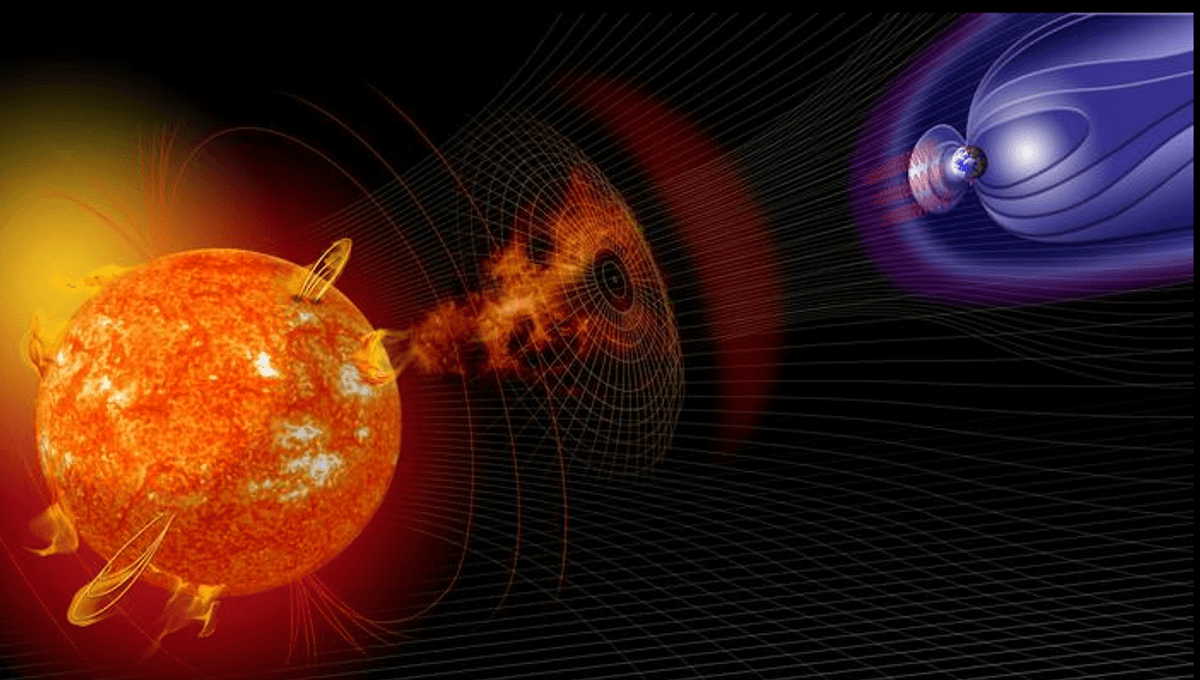
The Sun is putting on quite a show this year, with an abundance of sunspots, solar flares, and coronal mass ejections. This level of activity is unusual for this point in the 11-year solar cycle, raising the possibility of even more dramatic events next year. Solar astronomers are reminded of past great storms, like the one in 1989 that caused a 9-hour blackout for millions of people, and the historic 1859 Carrington Event that shocked telegraph operators.
Understanding the frequency of these events is crucial, especially considering the potential damage they can cause to our electricity-dependent society. However, there may be something even more significant than the Carrington Event. A recent Anglo-French study has uncovered evidence of a much larger solar storm.
During big solar storms, there is an increase in radioactive isotopes on Earth. Carbon-14, for example, is created when high-energy particles from space collide with nitrogen atoms in the atmosphere. This is then absorbed by living organisms, including trees, leaving a distinct spike in the following year’s growth rings. Other isotopes, like beryllium-10, can be found in ice cores in Greenland or Antarctica.
Researchers examined 140 partially fossilized Scots Pine trunks trapped in the banks of the Drouzet River, which are now eroding out. By comparing the widths of the tree rings, they were able to piece together a longer timeline using dendrochronology. This rare collection of preserved trees provided valuable insights into past solar events.
The team was particularly interested in Miyake Events, which are marked by spikes in carbon-14. These events are often associated with powerful solar storms. The study identified six to eight Miyake Events, with the oldest one dating back over 9,000 years. The partially fossilized trees from Drouzet revealed another event that occurred 14,300 years ago.
To confirm the significance of these events, the researchers also analyzed beryllium-10 in Greenland ice cores. They found a matching spike at the same time, which was twice the size of the 774 CE Miyake event and larger than any other recorded event. It would have been at least 10 times the size of the Carrington Event.
While some researchers have doubts, this study attributes the radioisotope spikes to solar activity. The details of these events, however, remain unclear.
One particularly interesting finding was a century-long spike in carbon-14 around 14,000 years ago. This coincided with a period of decreased solar wind, exposing the Earth to additional cosmic rays and resulting in a less intense but longer-lasting increase in radioactive isotope production. This period aligns with a planetary cooling period known as the Older Dryas.
The potential impacts of extreme solar storms on Earth are significant. They could cause widespread blackouts lasting months, damage satellites crucial for navigation and communication, and pose severe radiation risks to astronauts. While it is possible to strengthen our systems to withstand larger storms, little has been done due to a combination of a relatively calm Sun and inadequate disaster planning.
Understanding our past is essential for predicting and mitigating future risks. This study provides valuable insights, but it is crucial for planners to take action based on this knowledge.
The study has been published in Philosophical Transactions of the Royal Society A.