Get ready for a spectacular show in the night sky! The highly anticipated Perseid meteor shower is making its annual return. This celestial event is set to reach its peak before dawn on Sunday, August 13, but you can start looking for meteors as early as nightfall on Saturday, August 12. If you find yourself in a dark site away from light pollution, you might be lucky enough to witness one meteor per minute during the peak of the shower.
“Conditions this year couldn’t be more perfect,” says Diana Hannikainen, Sky & Telescope’s Observing Editor. “The waning crescent moon, which is only 8% illuminated, rises in the wee hours of the morning on August 13 and won’t interfere with viewing.” Don’t worry about staying up late or even all night, as the peak coincides with a weekend night. The only things that could hinder your enjoyment are clouds or light pollution, so find a spot with clear skies and minimal artificial light.
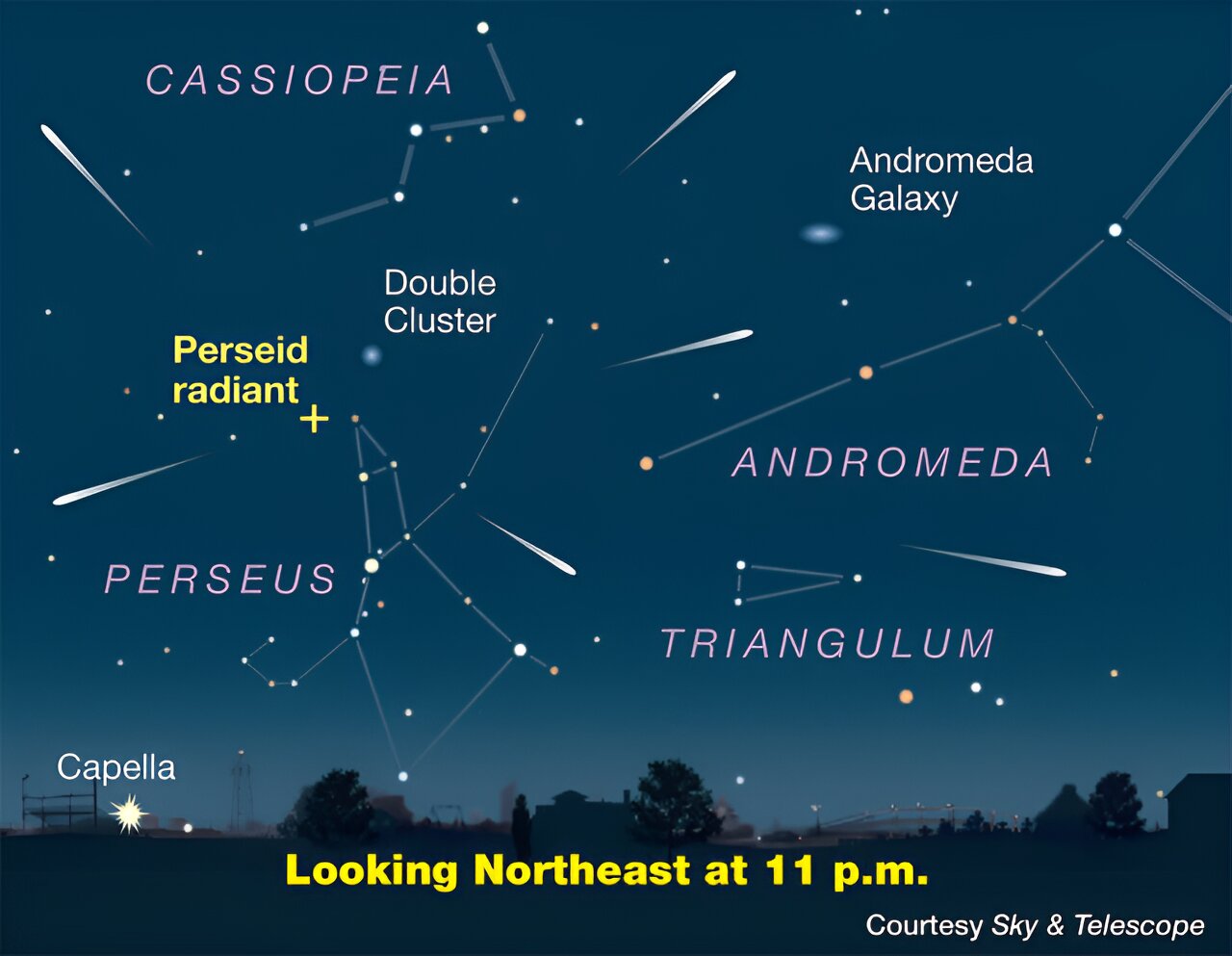
Start watching for meteors after evening twilight ends on August 12. As the shower’s radiant point in the constellation Perseus rises above the northeastern horizon, you may catch a glimpse of spectacularly long “earthgrazers” skimming along the top of the atmosphere. The higher the radiant, the more meteors you’ll see. So, as Perseus climbs higher in the northeast, especially after midnight, be prepared for an increase in meteor activity. The Perseids are a long-lasting event, so you may still see meteors for several nights before and after the peak.
To fully enjoy the Perseids, all you need are your eyes. Binoculars and telescopes won’t be useful for meteor-watching as they show too small an area of the sky. Find a dark spot away from bright lights with a wide-open view all around if possible. Make yourself comfortable by bringing a reclining lawn chair or picnic blanket. Bundle up in blankets or a sleeping bag to stay warm and shield yourself from mosquitoes. Remember to relax, be patient, and let your eyes adapt to the darkness.
These “shooting stars” can appear anywhere in the sky, so you don’t have to look towards the radiant to see them. The best direction to watch is wherever your sky is darkest, usually straight up. Faint Perseids will appear as quick streaks, while occasional brighter ones may sail across the sky for several seconds, leaving a brief train of glowing smoke.
When you spot a meteor, trace its path back to its origin. If you end up at the constellation Perseus, you’ve just witnessed a Perseid. Occasionally, you might see meteors from other showers or random “sporadic” meteors. It can be a fun exercise to trace meteors back to their radiants and determine their origin. Just remember, if the tracks don’t lead you to Perseus, they aren’t Perseids.
Light pollution and cloudiness can reduce the number of visible meteors. However, the brightest ones can still shine through light pollution. In fact, a NASA analysis shows that the Perseids deliver more bright meteors than any other annual meteor shower.
How and why
Meteors are caused by tiny bits of dusty debris striking Earth’s atmosphere. Each Perseid travels at an incredible speed of 37 miles per second, creating a white-hot streak of superheated air. The size, color, and texture of typical meteor-shower particles are similar to the nuggets in Grape Nuts cereal.
The Perseid meteor bits were shed by Comet Swift-Tuttle and are scattered along the comet’s orbital path around the sun. Every year in mid-August, Earth passes through this “river of rubble.” The comet was named after Lewis Swift and Horace Parnell Tuttle, who independently discovered it in July 1862.