Rice University physicists have made an exciting discovery in the field of quantum computing. They have found that highly sought-after immutable topological states can be entangled with other manipulable quantum states in certain materials.
“The surprising thing we found is that in a particular kind of crystal lattice, where electrons become stuck, the strongly coupled behavior of electrons in d atomic orbitals actually act like the f orbital systems of some heavy fermions,” said Qimiao Si, co-author of a study about the research in Science Advances.
This unexpected discovery bridges the gap between different subfields of condensed matter physics. In topological materials, quantum entanglement creates “protected” states that could revolutionize quantum computing and spintronics. In strongly correlated materials, the entanglement of countless electrons leads to phenomena like unconventional superconductivity and continuous magnetic fluctuations in quantum spin liquids.
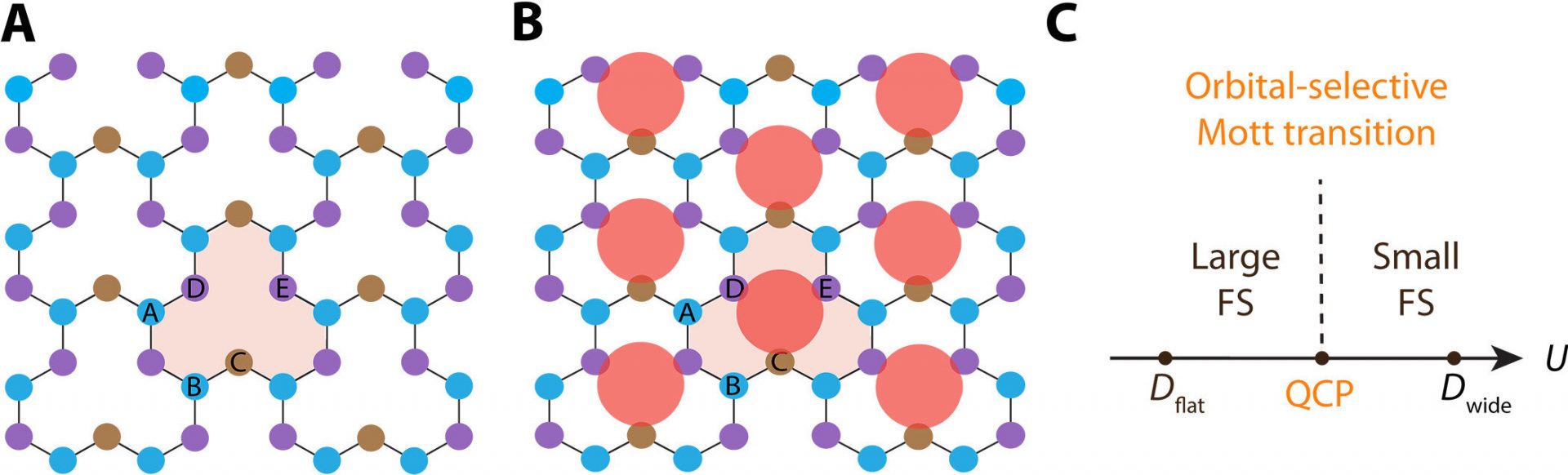
In their study, Si and co-author Haoyu Hu built and tested a quantum model to investigate electron coupling in a “frustrated” lattice arrangement found in metals and semimetals with “flat bands.” These flat bands trap electrons and amplify strongly correlated effects.
This research is part of Si’s ongoing effort to validate a theoretical framework for controlling topological states of matter.
Si and Hu demonstrated that electrons from d atomic orbitals can become part of larger molecular orbitals shared by multiple atoms in the lattice. They also showed that electrons in molecular orbitals can become entangled with other frustrated electrons, resulting in familiar strongly correlated effects observed in heavy fermion materials.
“These are completely d-electron systems,” Si explained. “In the d-electron world, it’s like you have a highway with multiple lanes. In the f-electron world, electrons move in two tiers. One is like the d-electron highway, and the other is like a dirt road, where movement is very slow.”
Si noted that while f-electron systems exhibit clean examples of strongly correlated physics, they are not practical for everyday use. “This dirt road lies so far from the highway,” he said. “The influence from the highway is very small, which translates to a minute energy scale and very low-temperature physics. Meaning you need to go to temperatures around 10 Kelvin or so to even see the effects of coupling.”
However, in the d-electron world, things couple to one another efficiently even in the presence of a flat band. Si compared it to one of the highway’s lanes becoming as inefficient and slow as the f-electron dirt road.
“Even when it has faded into a dirt road, it still shares status with the other lanes because they all came from the d orbital,” Si explained. “It is effectively a dirt road, but it is much more strongly coupled, and that translates to physics at much higher temperatures.”
This breakthrough means that the exquisite physics of f-electron systems, which Si has extensively studied, can potentially be achieved at higher temperatures, even at room temperature. Si is optimistic about the functionality of this discovery.
Si is the Harry C. and Olga K. Wiess Professor of Physics and Astronomy at Rice University, a member of the Rice Quantum Initiative, and the director of the Rice Center for Quantum Materials (RCQM).