The extraction of specific gas molecules from gaseous mixtures is a complex challenge with significant rewards. Imagine capturing carbon dioxide (CO2) from industrial exhaust gases or the atmosphere to help combat climate change. Well, researchers at Kyoto University, along with colleagues in China, have just reported a new and energy efficient option in the prestigious journal Nature Communications.
“Our work demonstrates exceptional molecule recognition and separation performance by deliberately organizing the pore geometry, structural flexibility, and molecular-level binding sites within a porous coordination polymer (PCP),” says chemist Susumu Kitagawa, leader of the research team at Kyoto University’s Institute for Integrated Cell-Material Sciences.
PCPs, also known as metal-organic frameworks (MOFs), have metal ions or clusters held together by organic (carbon-based) linker groups. By choosing different metallic components and adjusting the size and structure of the organic groups, scientists can create a wide range of crystalline materials with finely controlled pores. But this new work takes it a step further, with pores that adapt when specific molecules bind to them.
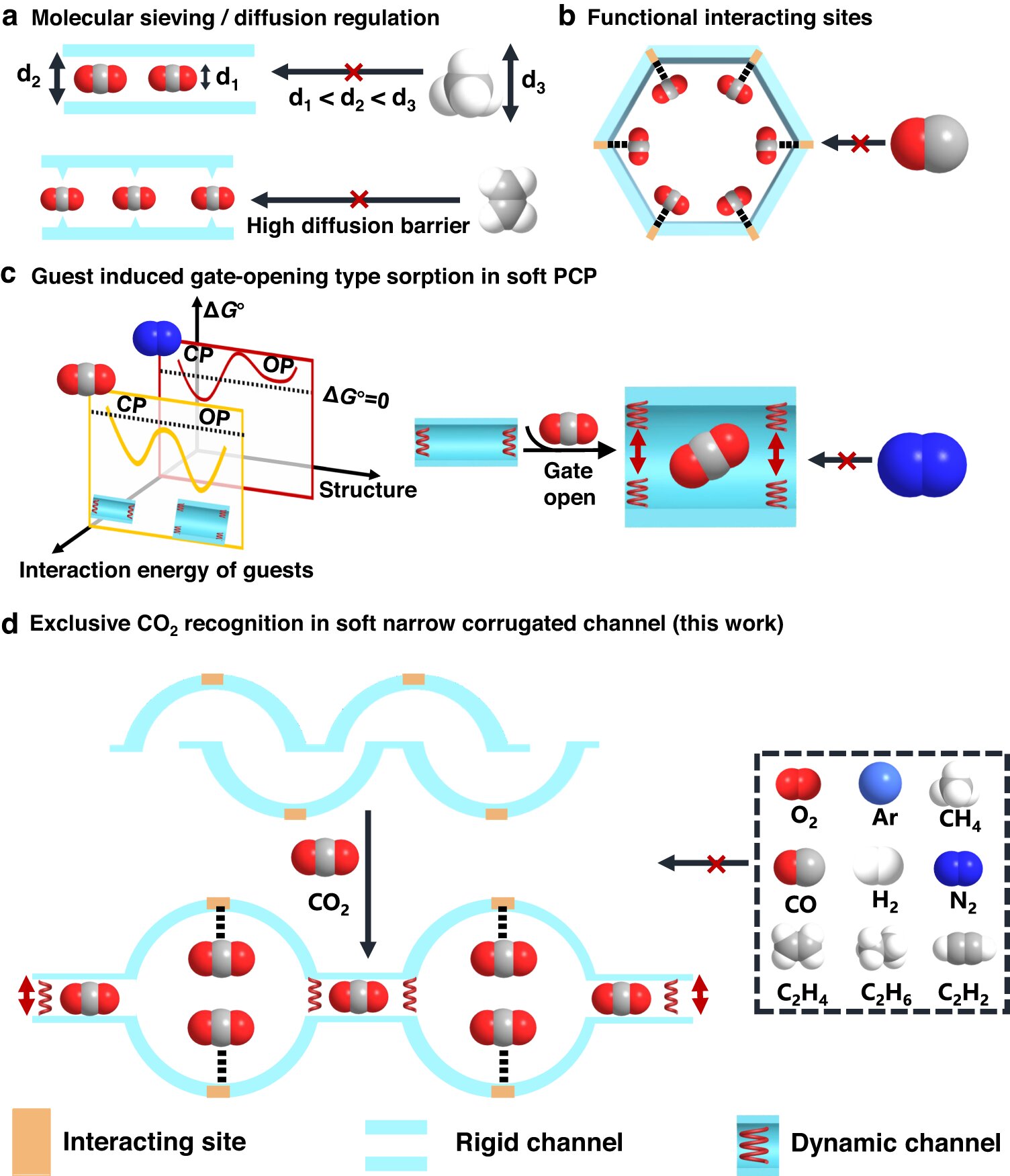
“We designed a flexible PCP with a corrugated channel system that can interact with and adsorb CO2 molecules by selectively opening pores that act as gates, allowing only the CO2 to pass through,” explains Ken-ichi Otake, another member of the Kyoto team. Capturing CO2 is particularly challenging due to its small size and low affinity for many adsorptive materials.
The technical term for what happens when CO2 interacts with the PCP is exclusion discrimination gating. This means that when CO2 binds to the PCP, it triggers a structural change that enhances the binding and opens up the solid phase structure, allowing the CO2 to enter.
To demonstrate the power of their system, the team used it to gather CO2 from mixtures containing various industrially significant molecules. The process proved to be significantly more energy efficient than existing options, making it a promising technology for low-carbon industrial processes and large-scale climate engineering efforts.
“By building on this initial success, future research will hopefully achieve more versatile breakthroughs in a wide range of selective gas extraction processes,” says Yifan Gu, the first author of the research report.