Did you know that light waves with spiral phase fronts can carry orbital angular momentum (OAM)? These unique “helical” light beams have become incredibly important in advanced technologies like communication, imaging, and quantum information processing. But understanding their exact structure has proven to be quite tricky.
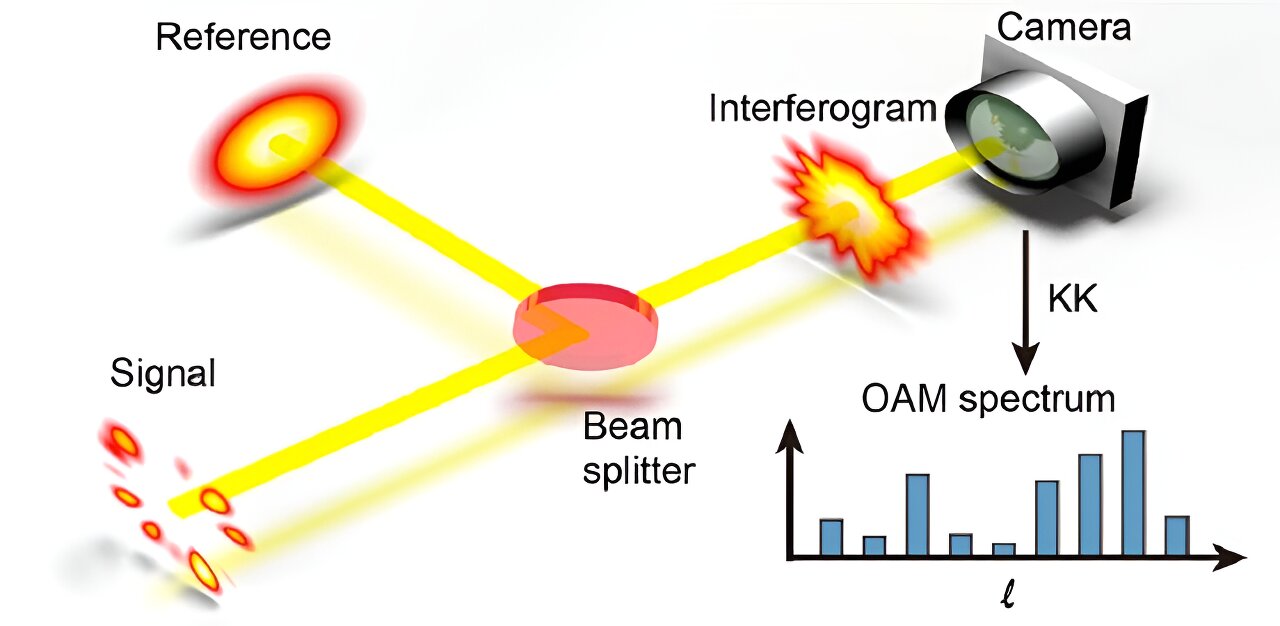
Interferometry, a technique that superimposes a light field with a known reference field, can help extract information from the interference. However, when it comes to measuring OAM spectrum information using a camera, there’s a complication known as “signal-signal beat interference” (SSBI). It’s like trying to distinguish overlapping sounds, making it difficult to retrieve the original notes.
But here’s where things get exciting. Researchers from Sun Yat-sen University and École Polytechnique Fédérale de Lausanne (EPFL) have made a breakthrough using a powerful mathematical tool called the Kramers-Kronig (KK) relation. This tool helps untangle the complex helical light pattern from the camera’s intensity-only measurements, enabling single-shot retrieval in simple on-axis interferometry. By exploring the duality between the time-frequency and azimuth-OAM domains, they were able to investigate various OAM fields.
This new measurement technique has incredible potential for advancing technologies that rely on these special light patterns. According to corresponding author Jianqi Hu, “The proposed method can also be generalized for OAM beams with complex radial structures, making it a powerful technique for real-time measurement of structured light fields, simply by a snapshot with a camera.”
Compared to conventional on-axis interferometry, the KK method not only accelerates the measurement but also simplifies and reduces costs. Thanks to this breakthrough, scientists now have a powerful means to unlock the secrets of structured light waves with OAM. This has the potential to revolutionize various technologies and pave the way for exciting advancements in the field of structured light.