Researchers from the RIKEN Center for Quantum Computing have made a groundbreaking discovery in the field of quantum computing. They have successfully used machine learning to perform error correction for quantum computers, a crucial step in making these devices practical. What makes their approach unique is the use of an autonomous correction system that can efficiently determine the best way to make necessary corrections, even though it is only approximate.
This exciting research has been published in the prestigious journal Physical Review Letters. Unlike classical computers that operate on bits with only two values, 0 and 1, quantum computers operate on “qubits” that can assume any superposition of computational basis states. Combined with quantum entanglement, which connects different qubits in ways that classical means cannot, quantum computers have the potential to revolutionize computational tasks such as large-scale searches, optimization problems, and cryptography.
However, the fragility of quantum superpositions poses a major challenge in putting quantum computers into practice. Even tiny perturbations caused by the environment can lead to errors that destroy quantum superpositions and diminish the power of quantum computers. To overcome this obstacle, researchers have developed sophisticated methods for quantum error correction. While these methods can theoretically neutralize errors, they often come with a significant increase in device complexity, which itself is error-prone and can exacerbate the problem. As a result, achieving full-fledged error correction has remained elusive.
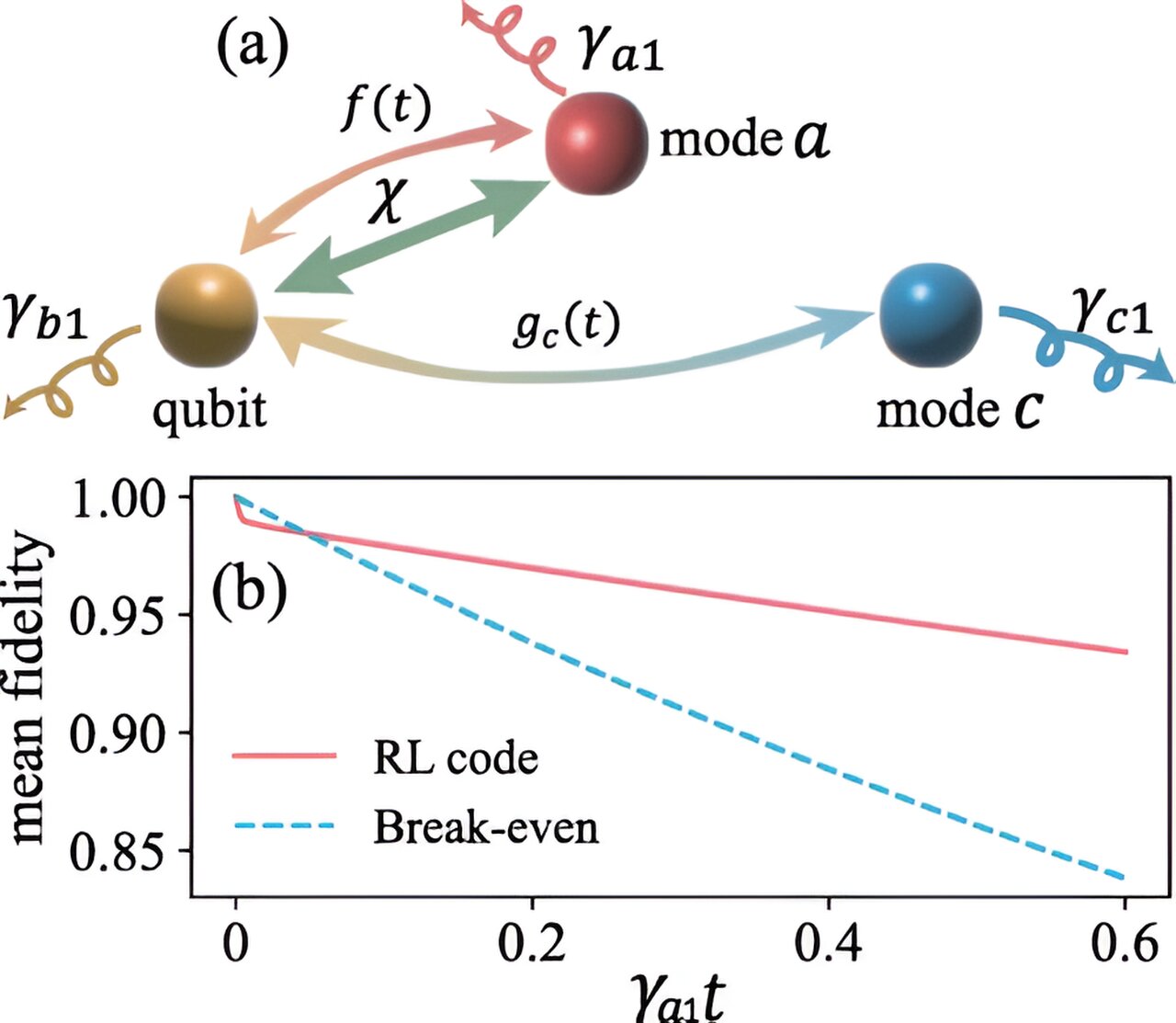
In this groundbreaking work, the researchers turned to machine learning to find error correction schemes that minimize device complexity while maintaining excellent error correcting performance. They focused on an autonomous approach to quantum error correction, where an artificial environment replaces the need for frequent error-detecting measurements. They also explored “bosonic qubit encodings,” which are utilized in some of the most promising quantum computing machines based on superconducting circuits. Finding the best candidates in the vast search space of bosonic qubit encodings was a complex optimization task, which the researchers tackled using reinforcement learning, an advanced machine learning method.
The results were astonishing. The researchers discovered that a surprisingly simple, approximate qubit encoding not only significantly reduced device complexity compared to other proposed encodings but also outperformed its competitors in terms of error correction capability. Yexiong Zeng, the first author of the paper, expressed excitement about the findings, stating, “Our work not only demonstrates the potential for deploying machine learning towards quantum error correction, but it may also bring us a step closer to the successful implementation of quantum error correction in experiments.”
Franco Nori, a leading expert in the field, emphasized the importance of machine learning in addressing the challenges of large-scale quantum computation and optimization. He mentioned ongoing projects that integrate machine learning, artificial neural networks, quantum error correction, and quantum fault tolerance.
This groundbreaking research opens up new possibilities for the future of quantum computing. With the potential to overcome the limitations of quantum superpositions, error correction using machine learning brings us closer to realizing the full potential of quantum computers in practical applications.