A group of international researchers led by the Center for Astrophysics | Harvard and Smithsonian (CfA) achieved the once-unimaginable four years ago: using a groundbreaking telescope to capture an image of a black hole.
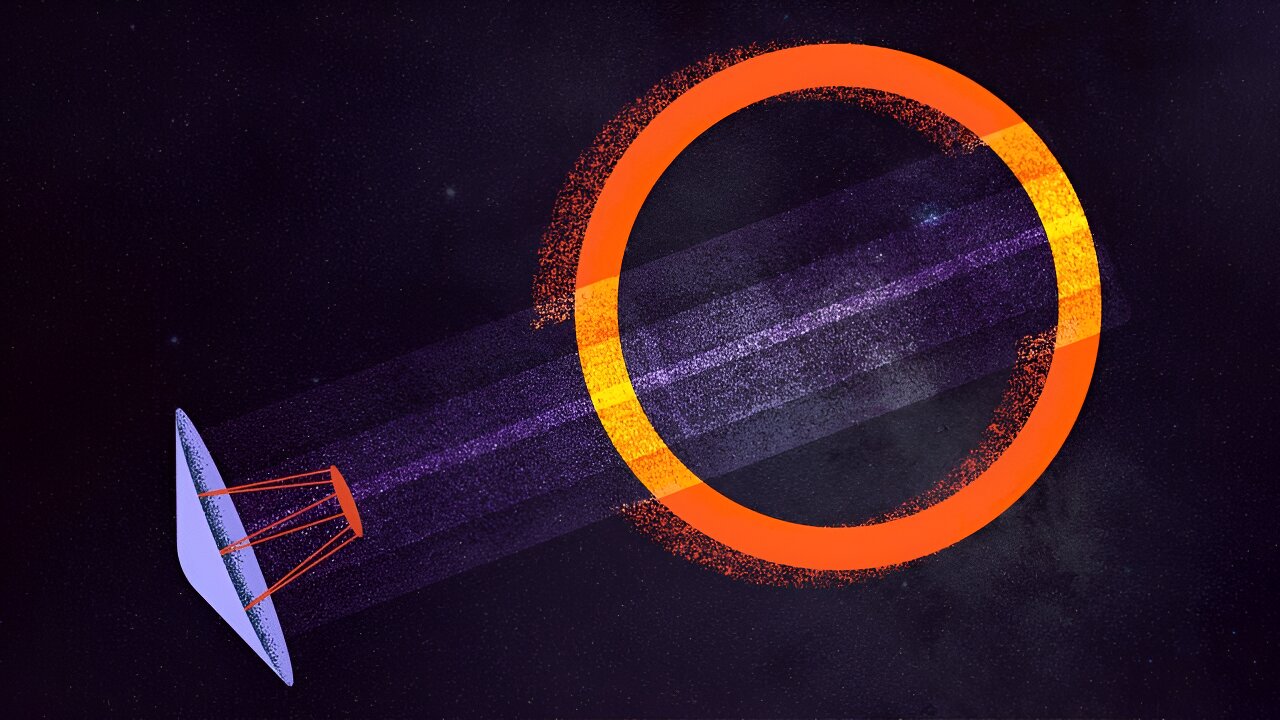
Last month, a team of researchers, engineers, and physicists gathered at Harvard to embark on an exciting new mission: studying the photon rings that encircle black holes in glowing orange. This mission, known as the Event Horizon Explorer (EHE), aims to provide further insight into the mysteries of black holes, which reside at the heart of galaxies.
Building upon the success of the Event Horizon Telescope (EHT) project in 2019, where the first-ever image of a black hole was captured, the $300 million EHE project seeks to enhance the sharpness of these images by a factor of 10. This improvement will allow scientists to observe photon rings, which are created by the light orbiting a black hole. Currently, these rings are too narrow to be distinguished from the surrounding light in EHT images.
Despite the immense challenges ahead, the team of over 70 researchers is optimistic about the project’s feasibility. “We think that we can keep our foot on the gas and actually get this built within the next decade,” says Janice Houston, a systems engineer at the CfA.
The concept behind the EHE mission may seem like something out of a Hollywood space odyssey. “Detecting the photon ring requires recording huge volumes of data on the spacecraft. We plan on using laser light to beam the information equivalent of the entire Library of Congress down to Earth,” explains Peter Galison, director of Harvard’s Black Hole Initiative.
The potential payoff of the EHE mission is immense. By measuring the photon ring, scientists could obtain solid evidence that black holes at the centers of galaxies are spinning and dragging space-time along with them. This would provide further validation of the mathematical model known as space-time, which describes the fabric of the cosmos.
Before the EHE can be launched, it must overcome significant challenges, such as building sensitive receivers and launching a precise telescope dish. However, the team remains determined to push the boundaries of engineering and explore new frontiers of the universe.
As the project progresses, scientists like Dominic Chang, who is studying physics at Harvard, are actively contributing to the theoretical physics driving the mission. Chang’s work involves building physics-based models that can describe the 3D geometry of space-time.
“This mission would have profound implications for multiple priority areas identified by the U.S. astronomy community,” says Peter Kurczynski, chief scientist of cosmic origins at NASA Goddard. “It’s an extraordinary opportunity for us to finally understand how the enormous black holes in the centers of galaxies actually formed.”
The workshop held at Harvard received guidance from FAS Dean of Science Christopher Stubbs, who commended the team’s achievement in imaging a black hole and emphasized the significance of leveraging this accomplishment to drive future progress.