Prepare to be amazed! A team of brilliant astrophysicists from the California Institute of Technology, the MIT Kavli Institute for Astrophysics and Space Research, and the University of Amsterdam has made an extraordinary discovery. They have found a binary system with two stars so incredibly small and close together that they could actually fit inside our very own sun! This mind-blowing revelation has been documented in a paper submitted to The Open Journal of Astrophysics and is currently available on the arXiv preprint server.
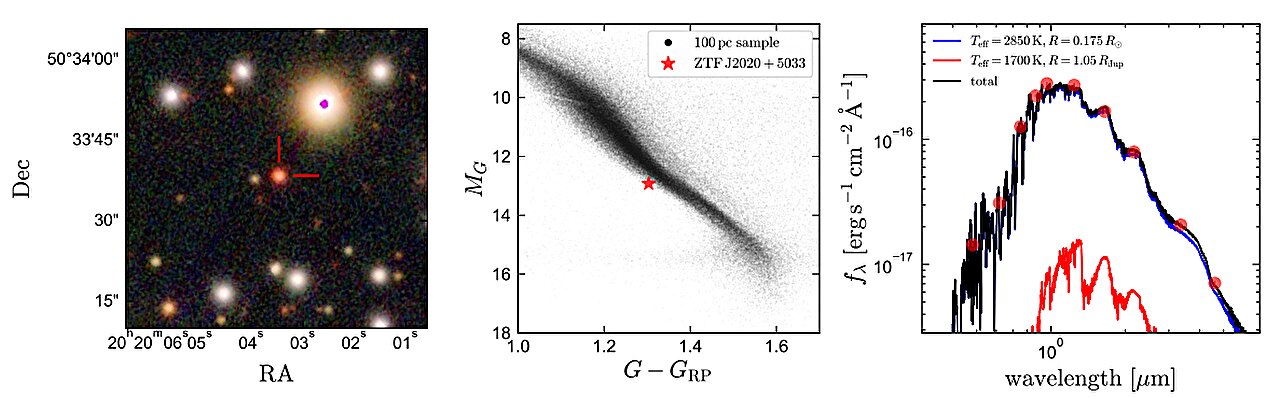
Prepare to have your mind blown even further! These two stars, known as ZTF J2020+5033, are located a mere 457 light-years away from our beloved Earth. That’s incredibly close in astronomical terms! What’s even more astonishing is that these stars, a brown dwarf and a red dwarf, orbit each other in a mind-bogglingly short 1.9-hour orbit—the closest orbit ever recorded for a brown dwarf.
Brown dwarfs are truly fascinating celestial objects. They are like glowing planets rather than traditional stars. While they are large enough to ignite fusion at their cores, they lack the necessary hydrogen to shine brightly. This makes them quite dim and challenging to observe and study. However, the presence of a red dwarf in this binary system provides a unique opportunity to learn more about these enigmatic brown dwarfs.
The research team made some intriguing discoveries about the sizes and masses of these stars. The red dwarf, despite being small for stars in its category, has a radius that is only 17.6% that of our sun and a mass of just 13.4%. On the other hand, the brown dwarf is surprisingly large for its category, with a radius comparable to that of Jupiter, but a whopping 80.1 times the mass of the gas giant.
But wait, there’s more! The data also suggests that this binary system is quite ancient, and the two stars were likely once larger and orbited each other at a greater distance. Furthermore, the team predicts that these stars will continue to move closer together. As they do, the brown dwarf, with its higher surface gravity, will eventually start siphoning material from the red dwarf. Talk about stellar cannibalism!
The research team is not stopping there. They are determined to delve deeper into the mysteries of this binary system, hoping to uncover more secrets about both brown and red dwarfs and unravel the fascinating story of how such a unique system came to exist.
,,,,