Electronic devices typically rely on the charge of electrons, but researchers are now exploring the potential of spin defects in crystalline materials. These spin defects have the ability to make quantum-based devices, such as quantum sensors and quantum memory devices, more efficient and powerful. However, measuring and controlling the spin density in these materials has proven to be challenging.
But now, a team of researchers from MIT and other institutions has made a breakthrough. They have discovered a way to tune the spin density in diamond by a factor of two using an external laser or microwave beam. This finding, published in the journal PNAS, opens up exciting possibilities for advanced quantum devices. The study was a collaboration between students of professors Paola Cappellaro and Ju Li at MIT, along with collaborators from Politecnico of Milano.
The lead author of the paper, Guoqing Wang Ph.D. ’23, conducted his research in Cappellaro’s lab and is now a postdoc at MIT.
One specific type of spin defect, known as a nitrogen vacancy (NV) center in diamond, has been extensively studied for its potential use in various quantum applications. NV centers are highly sensitive detectors due to their ability to detect any physical, electrical, or optical disturbance. Unlike many other quantum systems, NV centers can operate under ambient, room-temperature conditions.
“Solid-state spin defects are one of the most promising quantum platforms,” says Wang. “Their nanoscale sensing capabilities make them ideal for studying the dynamics in their spin environment and exploring quantum many-body physics.”
However, to fully utilize these spin defects, scientists need to be able to change the spin density, which has been a challenge until now. With this new approach, Wang explains, “We can tune the spin density, providing a potential knob to control the system. That’s the key novelty of our work.”
This tunable system could revolutionize the study of quantum hydrodynamics and improve the sensitivity of existing nanoscale quantum-sensing devices.
Professor Ju Li, who holds a joint appointment in MIT’s departments of Nuclear Science and Engineering and Materials Science and Engineering, explains that traditional computers and information processing systems are based on the control and detection of electrical charges. However, spin-based devices, which couple spin and charge, offer the potential for more energy-efficient computing.
In their study, Li and his colleagues achieved unprecedented control over spin density, allowing each NV center to act as a quantum sensor that can sense and control nearby spins. This breakthrough could pave the way for devices where a single point defect or atom becomes the basic computational unit.
While there is still much work to be done to fully understand the physical mechanisms behind these effects, the researchers are excited about the potential applications of their findings. They hope to further explore quantum simulation and sensing ideas, such as simulating quantum hydrodynamics and transporting quantum information between different spin defects.
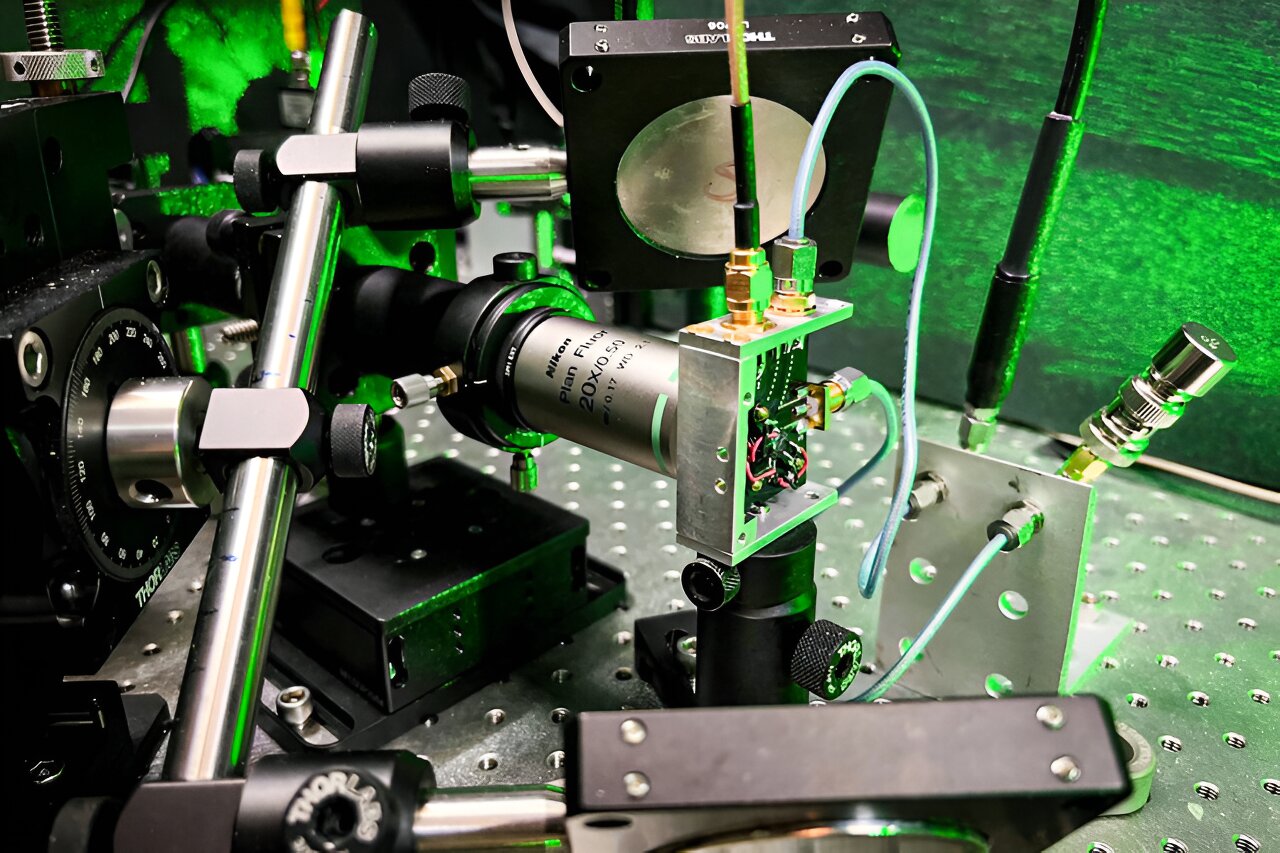
The team’s development of a new wide-field imaging setup has been instrumental in their research. This setup allows them to measure multiple spatial locations within the crystalline material simultaneously, providing valuable insights into the density distribution and charge transport dynamics.
Although their work was conducted using lab-grown diamond, the principles they have discovered could be applied to other crystalline solid-state defects. This opens up possibilities for a wide range of applications in the field of solid-state spin defects.
Overall, this breakthrough is an exciting development for the field of solid-state spin defects, according to Chong Zu, an assistant professor of physics at Washington University in St. Louis. The ability to continuously tune the local spin defect density using charge ionization dynamics is crucial for the advancement of quantum simulation and sensing using NV centers.