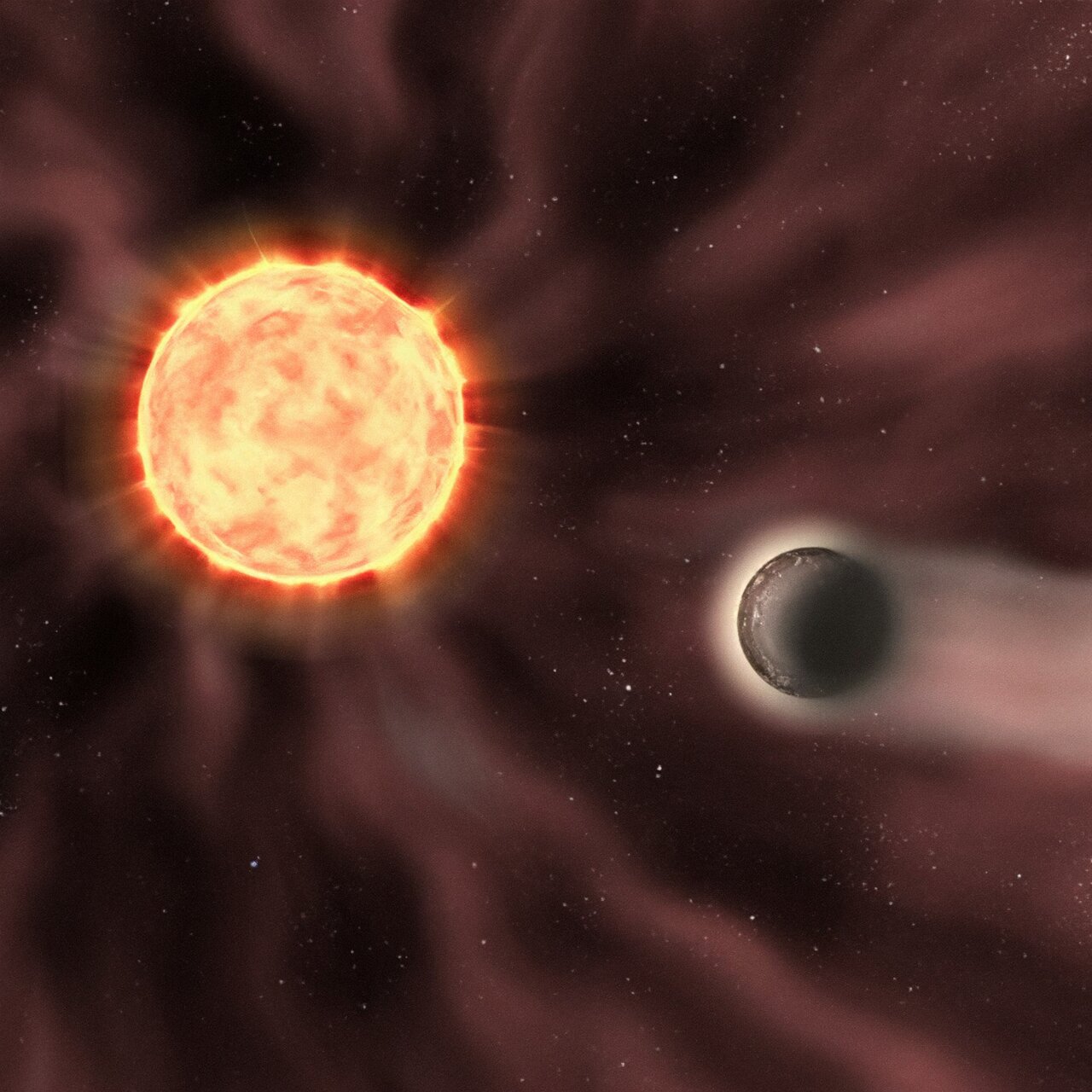
Prepare to be amazed! Scientists at the Leibniz Institute for Astrophysics Potsdam (AIP) have made a groundbreaking discovery using cutting-edge numerical simulations. They have successfully characterized the properties of stellar winds in cool stars for the first time ever. And guess what? They found that stars with stronger magnetic fields produce more powerful winds. But here’s the catch: these winds can actually make it difficult for planetary atmospheres to survive, potentially affecting the habitability of these systems.
But what exactly are cool stars? Well, they are among the most abundant stars in the universe. These stars are categorized into F, G, K, and M-types based on their size, temperature, and brightness. Our very own sun is a G-type star, while stars brighter and larger than the sun fall into the F category. K stars are slightly smaller and cooler than the sun, and the smallest and faintest stars are the M stars, also known as “red dwarfs.”
Did you know that the sun emits more than just light? It also releases a constant stream of particles called the solar wind. These winds travel through space and interact with the planets in our solar system, including Earth. In fact, the beautiful aurorae near the poles are a result of this interaction. However, these winds can also be harmful, eroding away stable planetary atmospheres like what happened on Mars.
While we know quite a bit about the solar wind, the same cannot be said for other cool stars. The problem is that we can’t directly observe these stellar winds, so we have to study their effects on the gas between stars in the galaxy. But this approach has limitations. That’s why scientists are turning to computer simulations and models to predict the properties of stellar winds without relying on direct observations.
In a groundbreaking study, scientists at the AIP, in collaboration with researchers from the Center for Astrophysics at Harvard & Smithsonian, have used advanced numerical simulations to study the stellar wind properties of F, G, K, and M stars. These simulations, based on observed magnetic field distributions of 21 well-studied stars, provide valuable insights into the characteristics of stellar winds.
By examining properties like gravity, magnetic field strength, and rotation period, the team discovered how these factors affect wind characteristics such as velocity and density. Their findings challenge previous assumptions about stellar wind speeds and provide a comprehensive understanding of wind properties across different types of stars. They even predicted the size of the Alfvén surface, which marks the boundary between a star’s corona and its stellar wind.
Why is this information important? Well, it helps determine whether a planetary system might experience strong magnetic interactions between the star and its planets. These interactions occur when a planet’s orbit enters or is embedded within the Alfvén surface of its host star.
The team’s findings revealed that stars with larger magnetic fields than the sun have faster winds. In some cases, these winds can be up to five times faster than the average solar wind speed. This has significant implications for the habitability of planets. F and G-type stars, similar to our sun, create milder wind conditions, while K and M-type stars have harsher wind environments. These intense stellar winds can greatly impact the potential atmospheres of planets.
While we already know about the interaction between rocky planets and the sun, this phenomenon hasn’t been extensively studied in exoplanetary systems. Understanding stellar winds is crucial for assessing similar processes between stellar winds and planetary atmospheres. This study fills a crucial gap in our knowledge, as previous information on stellar winds for F to M main sequence stars was unknown.
Although this study focused on 21 stars, the results can be applied to other cool main sequence stars. This research opens up new avenues for studying stellar wind observations and their effects on planetary atmospheres. Exciting times lie ahead!