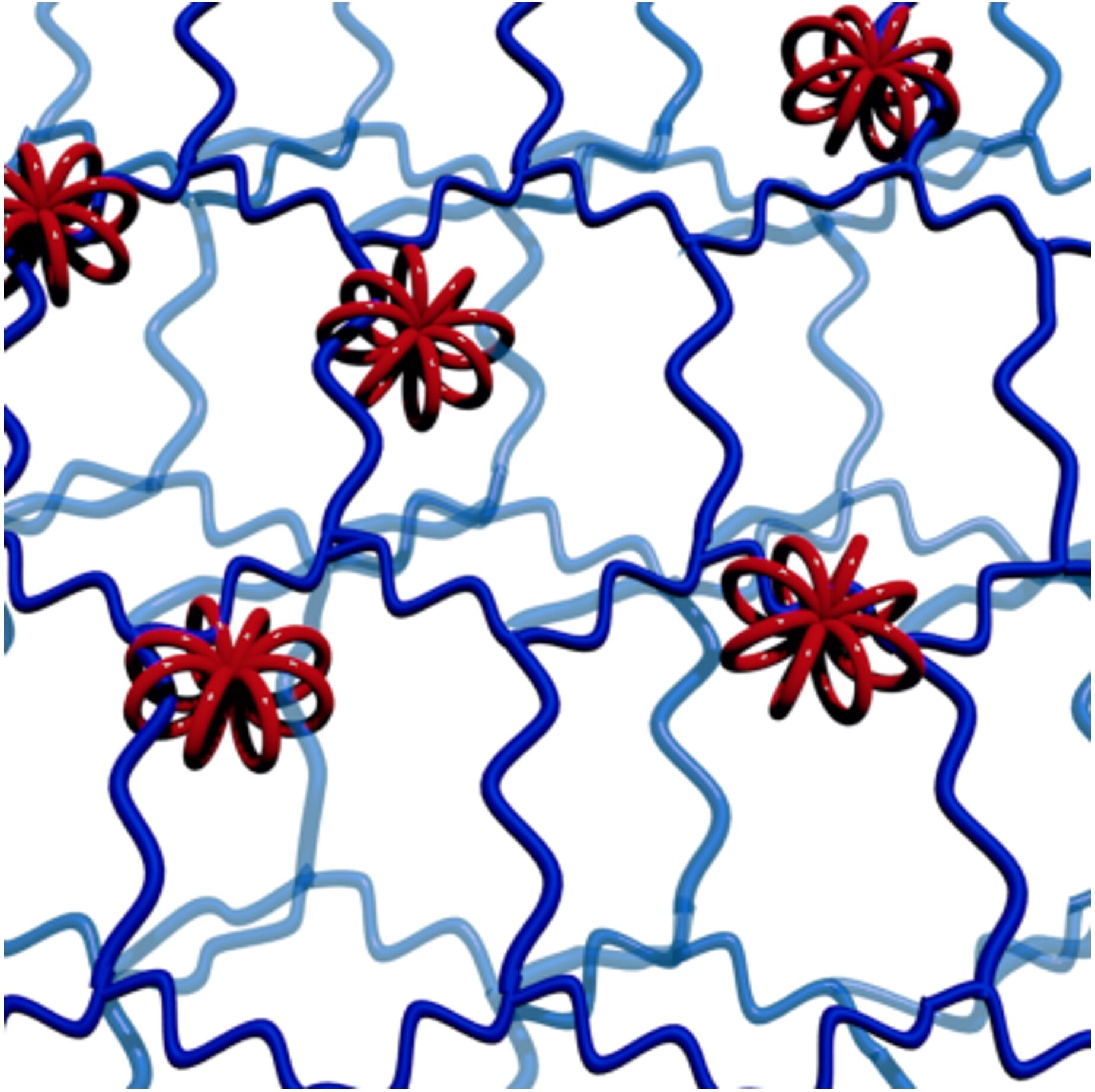
Get ready to dive into the fascinating world of rotaxanes – interlocked molecular structures that are revolutionizing the field of chemistry. These incredible structures consist of a linear ‘axle’ molecule penetrating one or more cyclic ‘wheel’ molecules, with bulky groups at the end of the axle preventing the wheels from coming off.
But now, prepare to be amazed as researchers at Hokkaido University take this technology to new heights. They have created macro-rotaxanes with multicyclic wheels interlocked with several high-molecular-weight axles. Their groundbreaking innovation is detailed in the prestigious journal Angewandte Chemie International Edition.
What makes this development so exciting is the wide range of potential applications for rotaxanes. From next-generation polymers to molecular computing, sensor technologies, and drug delivery, the possibilities are endless.
The team at Hokkaido University, in collaboration with researchers across Japan, is particularly interested in creating new network polymers. These polymers consist of complex ring structures that hold together different strands of long polymer chains.
“We believe that the multicyclic structures in these macro-rotaxanes could serve as non-leaching additives, permanently retained in a polymer network by their strong grip on neighboring polymer chains,” explains Professor Toshifumi Satoh, a polymer chemist leading the Hokkaido team.
The 3D wheels in these macro-rotaxanes act as unique and highly flexible molecular crosslinks, allowing for greater freedom of movement compared to traditional cross-linked networks. By manipulating the structure, researchers can fine-tune the properties of soft materials, making them suitable for various industrial and medical applications.
While other research groups have achieved similar success with smaller molecular arrangements, the breakthrough at Hokkaido University takes the field to a whole new level with larger molecules.
To explore the potential of this groundbreaking development, the researchers used polydimethylsiloxanes (PDMSs) to create the multicyclic rings. By combining these rings with silicone polymer chains and short crosslinking agents, they successfully incorporated the multicyclic units into a newly-forming extended, mixed, and interlocked network.
“We tested the damping performance of these networks, which measures their ability to absorb and reduce vibrations. The results were astonishing – our macro-rotaxanes showed significant improvements in damping efficiency compared to conventional polymer networks,” reveals Satoh.
Excitingly, this is just the beginning. Satoh and his colleagues have big plans to build upon their current progress and explore even more possibilities in the field of polymer chemistry. Stay tuned for more groundbreaking discoveries from this innovative team.