Polymeric materials are not just ordinary substances – they are the backbone of our everyday lives. Scientists have been tirelessly searching for new functional materials, and their attention has turned to polymers made up of rigid aromatic frameworks. These polymers possess incredible electronical and optical properties, as well as heat resistance and mechanical advantages.
However, there is a challenge that arises due to their high rigidity and strong self-aggregation – aromatic polymers are insoluble in organic solvents and water. This makes it difficult to process and further develop these materials. Current solubilization methods require the installation of side-chains onto the polymer backbone, which is both laborious and costly, and often leads to undesired changes in properties.
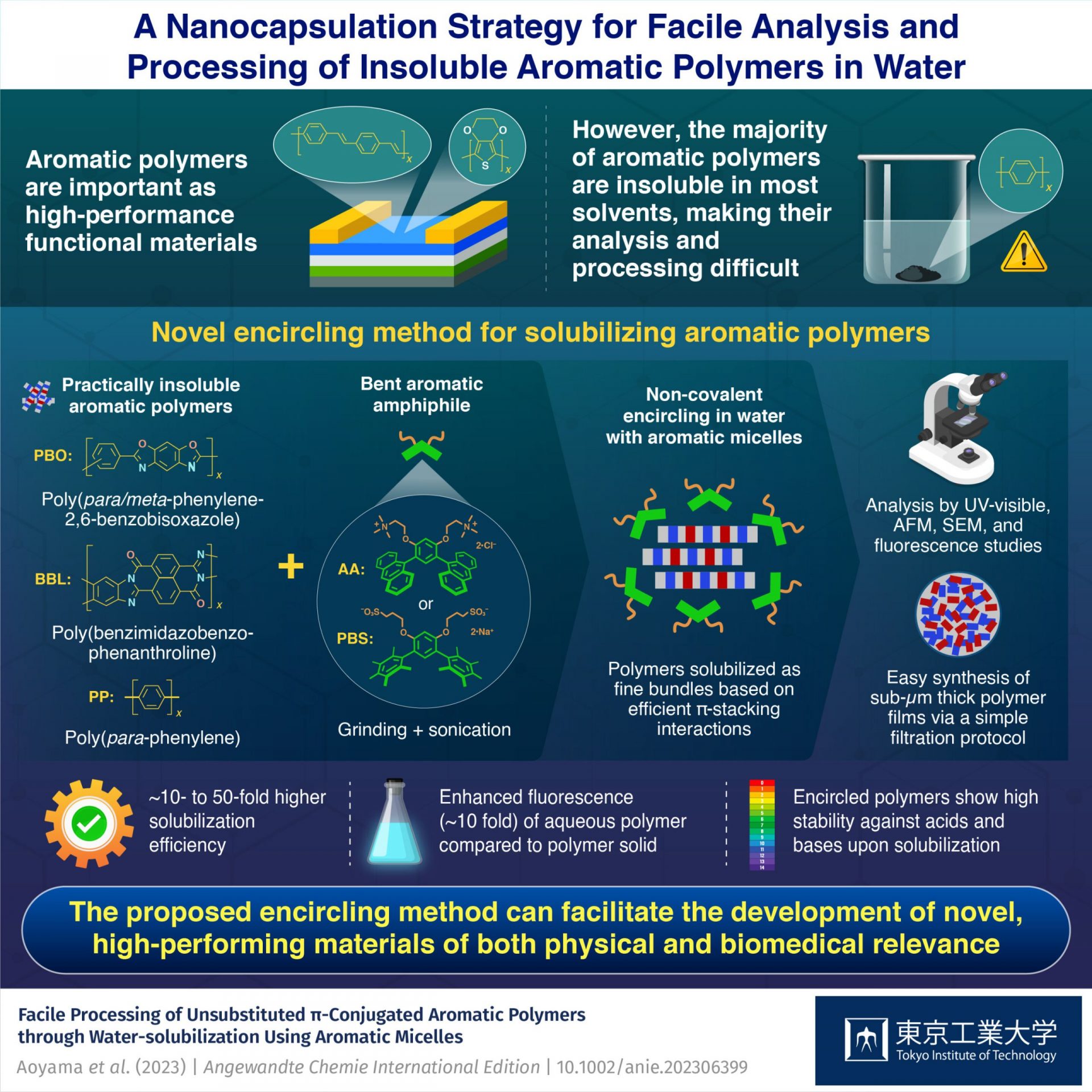
But fear not! Scientists from Tokyo Tech’s Laboratory for Chemistry and Life Science in Japan have come up with a solution. They have studied the water-solubilization of these hard-to-handle, insoluble aromatic polymers using bent aromatic amphiphiles, also known as surfactants.
In their publication in Angewandte Chemie, Shinji Aoyama, Lorenzo Catti, and Michito Yoshizawa demonstrate the effectiveness of their anthracene-based amphiphile—AA—and its pentamethylbenzene derivative—PBS—in solubilizing various insoluble aromatic polymers in water through encircling.
AA and PBS belong to a new class of amphiphiles that have a hydrophobic bent aromatic framework with two hydrophilic side-chains. In water, these aromatic amphiphiles form micelle-like nanocapsules that can encapsulate a wide variety of hydrophobic molecules.
To achieve water-solubilization, the polymer and aromatic amphiphile underwent a simple grinding-sonication protocol. UV-visible analysis of the resulting clear aqueous solutions revealed new absorption bands derived from the solubilized polymers.
The methodology proved to be highly versatile, successfully solubilizing several polymers including poly(para-phenylene-2,6-benzobisoxazole)) (PBO; Zylon), poly(benzimidazobenzophenanthroline) (BBL), and notoriously insoluble poly(para-phenylene) (PP). The water solubilization efficiency was found to be more than 50 times higher than that achieved with conventional amphiphiles (SDS and DTAC).
“Besides efficient water-solubilization, we were surprised to find that the resultant PP solution exhibits unprecedented strong bluish fluorescence (30% quantum yield (FF)). While PP shows only weak fluorescence in the solid state, the fluorescence could be increased by a factor of ~10 using our nanocapsulation strategy,” says Dr. Catti.
Structural analysis of the solubilized polymers was conducted using atomic force microscopy (AFM). The data, combined with molecular modeling studies, indicated that the polymers were solubilized as small bundles (~1 nm in thickness) encircled by the aromatic amphiphiles.
Importantly, the solubilized polymers could be processed into thin films through a simple filtration protocol. The resulting sub-micrometer thick films consisted of a compact network of tightly entangled polymer fibers, as confirmed by scanning electron microscopy (SEM). Filtration of mixed polymer solutions also allowed for the creation of multicomponent polymer films (e.g., PBO-BBL). The amphiphiles used in the process were fully reusable, contributing to the sustainability of the methodology.
The team concludes, “While this study focused on 1D polymers, we are confident that the method’s generality will enable us to process a wide range of 2D and 3D polymers in the future. Doping and processing these polymers is expected to contribute to the development of unprecedented aromatic materials.”