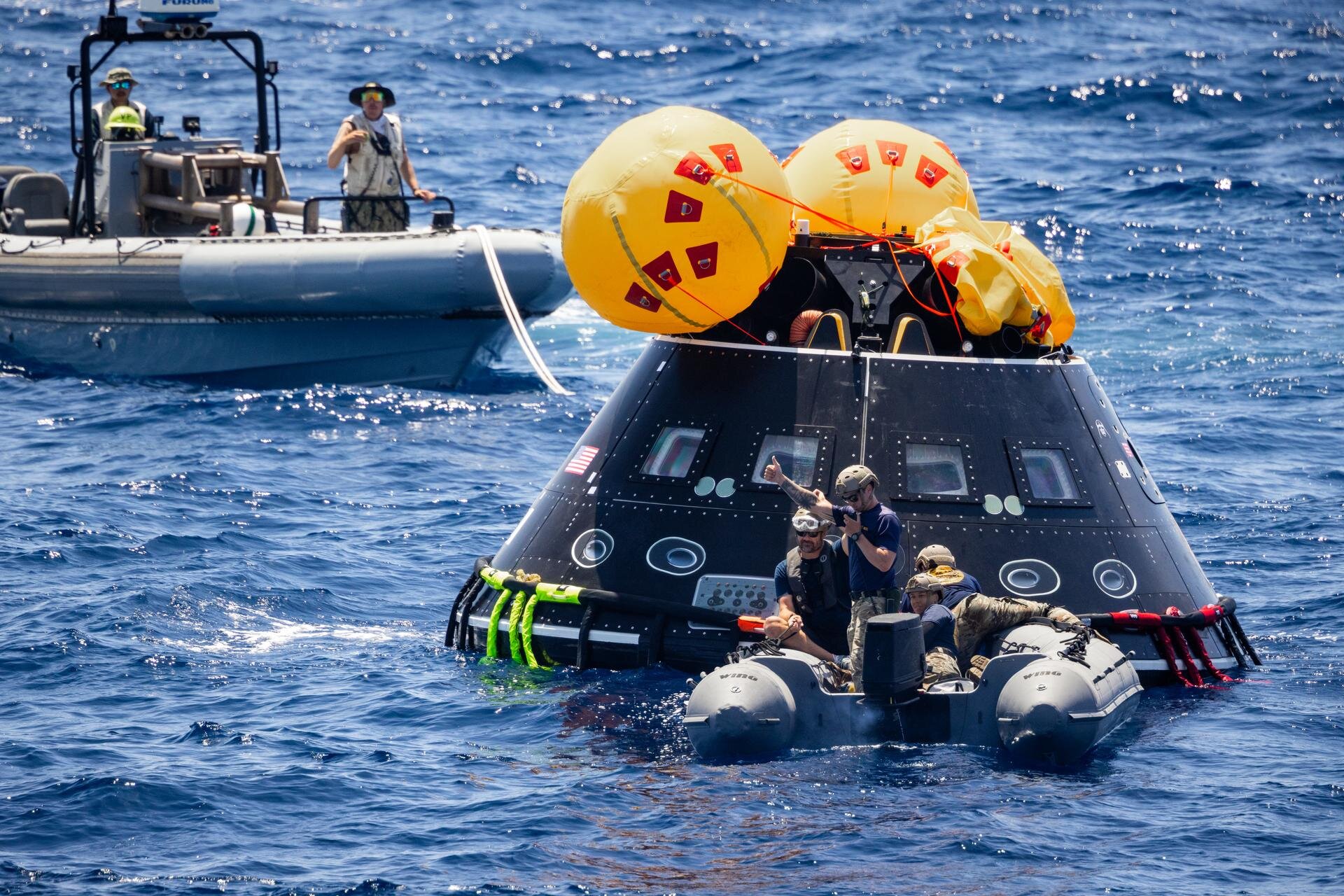
Get ready for an epic splashdown! When Artemis II NASA astronauts Reid Wiseman, Victor Glover, Christina Hammock Koch, and Canadian Space Agency astronaut Jeremy Hansen return from their 10-day mission around the moon, NASA’s landing and recovery team will be there to bring them back to land.
A crucial part of the capsule recovery and crew safety is NASA’s Search and Rescue office. Based at the Goddard Space Flight Center in Maryland, this office is managed by the Space Communications and Navigation (SCaN) program at NASA Headquarters.
For over 40 years, the search and rescue office has been instrumental in developing technologies for the international Cospas-Sarsat Program. These technologies have saved over 50,000 Earth explorers and now they are being applied to support NASA’s Artemis moon missions.
As part of Artemis II, NASA is equipping the astronauts with Advanced Next-Generation Emergency Locators (ANGEL) beacons. These palm-sized devices will be integrated into the astronauts’ life preservers and the Orion capsule, ensuring quick location in case of contingencies.
Cody Kelly, NASA search and rescue mission manager for national affairs, emphasized the importance of their role in human spaceflight: “Our astronauts are one of our most valuable resources and everything we’ve done in the last few years with Orion and Artemis has been to make sure we can really embody the Artemis goals not just of exploration, but bringing the crew safely home.”
In addition to contingency planning, the search and rescue office tracks Orion on its return to Earth. Using the search and rescue intelligent terminal (SAINT), they can determine the exact splashdown location by tracking Orion’s beacon. This system was successfully tested during the uncrewed Artemis I mission in 2022.
The search and rescue team recently conducted the Artemis Underway Recovery Test 10, where they validated their mission posture and tested the functionality of ANGEL, SAINT, and Orion’s beacon. They also simulated different recovery scenarios to ensure seamless communication and hardware performance.
While the team hopes they won’t need to use the ANGEL beacons during the Artemis II mission, NASA’s Search and Rescue office is standing by, ready to track the Orion capsule and ensure the safe return of the astronauts.