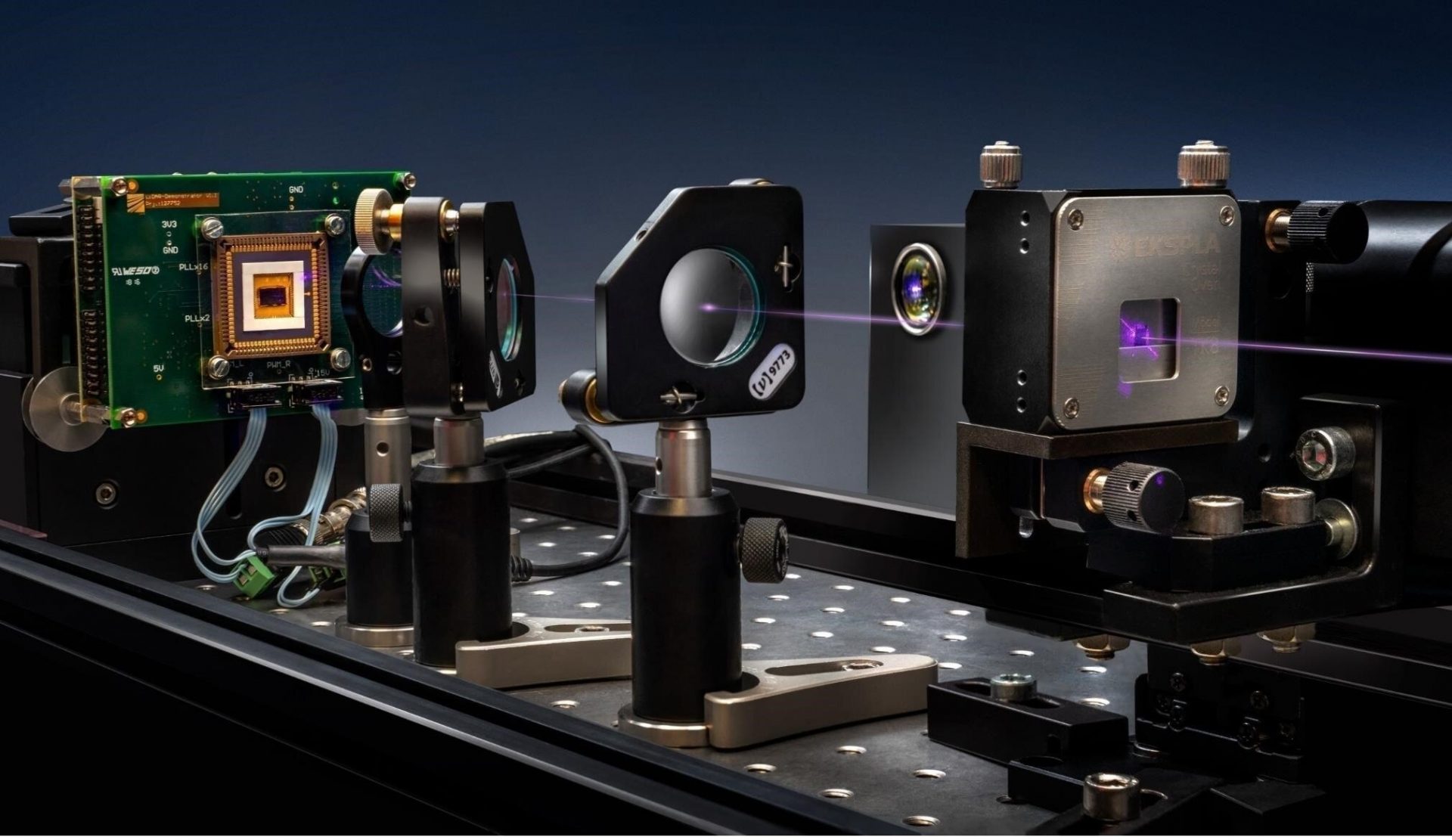
Prepare to be amazed! Researchers have just achieved the first-ever 3D measurements using quantum ghost imaging. This groundbreaking technique allows for 3D imaging at the single photon level, resulting in the lowest possible photon dose for any measurement.
Imagine the possibilities! “3D imaging with single photons could revolutionize biomedical applications, such as eye care diagnostics,” says researcher Carsten Pitsch from the Fraunhofer Institute of Optronics, System Technologies and Image Exploitation and Karlsruhe Institute of Technology, both in Germany. “It can be used to image materials and tissues that are sensitive to light or drugs that become toxic when exposed to light, without any risk of damage.”
In their publication in Applied Optics, the researchers describe their innovative approach, which incorporates new single photon avalanche diode (SPAD) array detectors. They apply this new imaging scheme, known as asynchronous detection, to achieve 3D imaging with quantum ghost imaging.
But wait, there’s more! “Asynchronous detection could also have military or security applications, allowing for covert observation while reducing the effects of over-illumination, turbulence, and scattering,” adds Pitsch. “We are also excited to explore its potential in hyperspectral imaging, which could enable simultaneous recording of multiple spectral regions with an incredibly low photon dose. This could be a game-changer for biological analysis.”
Adding a third dimension
Let’s dive deeper into the science behind quantum ghost imaging. This technique creates images using entangled photon-pairs, where only one member of the pair interacts with the object. By analyzing the detection time for each photon, entangled pairs can be identified, allowing for image reconstruction. This not only enables imaging at extremely low light levels but also eliminates the need for the objects being imaged to interact with the photons used for imaging.
Previous setups for quantum ghost imaging couldn’t achieve 3D imaging because they relied on intensified charge-coupled device (ICCD) cameras. While these cameras have good spatial resolution, they are time-gated and don’t allow for independent temporal detection of single photons.
But fear not! The researchers have developed a new setup based on state-of-the-art single photon avalanche diode (SPAD) arrays, originally designed for LiDAR and medical imaging. These detectors have multiple independent pixels with dedicated timing circuitry, enabling them to record the detection time of every pixel with picosecond resolution.
Their innovative approach involves using two entangled photons—a signal and an idler—to obtain 3D images with single photon illumination. The idler photons are directed onto the object, while the backscattered photons are detected in time. Simultaneously, the signal photons are directed to a dedicated camera that detects as many photons as possible in both time and space.
By comparing the detection time of each pixel with the detection of the single-pixel detector, the researchers can reconstruct the entanglement and determine the depth of the object based on the time of flight of the interacting idler photons.
An adaptable setup
But wait, there’s even more innovation! The researchers have also implemented periodic poling of the KTP crystal used to create the entangled photons. This allows for highly efficient quasi-phase matching, giving them the freedom to choose the wavelengths for illumination and imaging. It also makes the setup adaptable to various applications and wavelengths.
To demonstrate the 3D capabilities of their asynchronous detection scheme, the researchers used two separate setups. One setup resembled a Michelson interferometer and acquired images using two spatially separated arms. This allowed them to analyze the performance of the SPAD and improve coincidence detection. The other setup used free-space optics and focused on specific applications. Instead of imaging with two separated arms, it imaged two objects in the same arm.
While more work is needed, both setups served as proof-of-concept demonstrations for this groundbreaking technique. The experiments also showed that asynchronous detection could be used for remote detection, which could be valuable for atmospheric measurements.
The researchers are now collaborating with a SPAD manufacturer to enhance the spatial resolution and duty cycle of the SPAD cameras. They also plan to replace the fiber-coupled idler detector with a faster free-space coupled detector that has recently become available. Additionally, they aim to apply the setup to hyperspectral imaging, enabling imaging in the crucial mid-infrared spectrum without the need for specialized detectors.