Scientists at particle accelerator facilities worldwide rely on powerful X-rays to uncover the secrets of atoms and molecules. Now, researchers from the Department of Energy’s SLAC National Accelerator Laboratory have discovered a way to make X-ray pulses at X-ray free-electron lasers (XFEL) even brighter and more reliable. Their solution involves building a special cavity chamber and diamond mirrors around an XFEL.
“We want to make our XFELs more laser-like,” said Zhirong Huang, a SLAC and Stanford professor of photon science. “We’ve been searching for a way to do this for decades, and with our new calculations, we demonstrate that this pipedream could become reality.”
Currently, XFELs like SLAC’s Linac Coherent Light Source (LCLS) produce X-ray pulses with varying power, resulting in temporally incoherent light rays. This inconsistency makes it challenging for scientists to conduct experiments effectively. However, the researchers have now shown how to generate coherent X-ray pulses using a crystal cavity and mirror system, without the need for an excessively long and complicated cavity.
“The motivation for generating coherent, higher brightness X-rays is to study real-world materials and their behavior under different conditions,” explained SLAC scientist and co-author Jingyi Tang. “We want to study dynamic systems that are difficult to capture.”
Storing light using mirrors
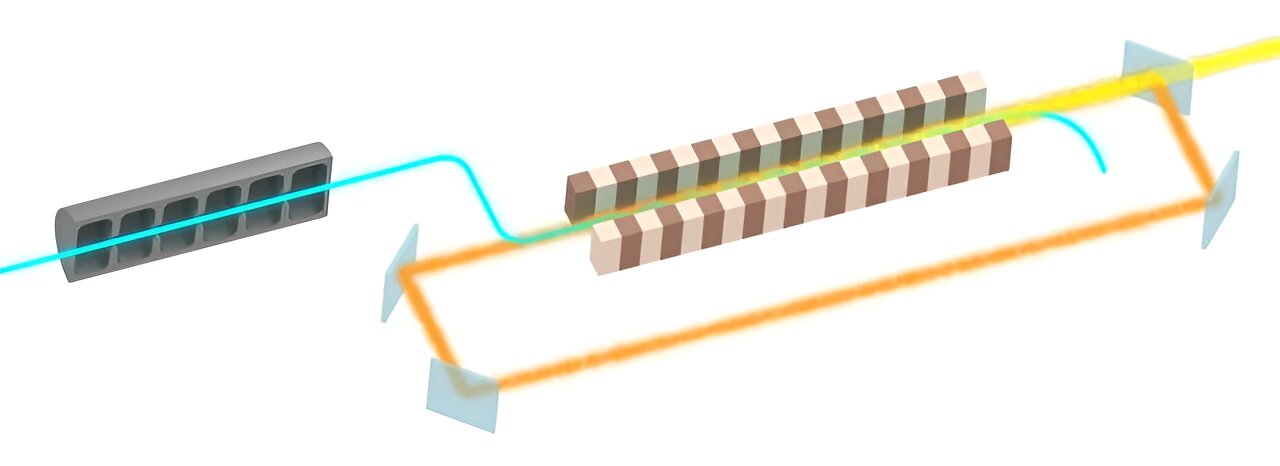
Although the idea of capturing X-rays with mirrors may seem impossible, it could be achievable at a high-repetition-rate accelerator like LCLS-II. The researchers focused on a cavity-based X-ray Free electron laser (CBXFEL) design, where a cavity structure captures incoherent X-ray pulses generated at an accelerator facility.
Inside the cavity, X-rays bounce off four diamond mirrors, causing the pulses to circulate. As the pulses travel around the cavity, the next electron bunch inside the accelerator approaches. When the bunch arrives, the bouncing X-ray pulse interacts with it, making it more organized and coherent. This improved electron bunch then produces brighter X-rays as it moves through the accelerator.
Previously, researchers believed that maintaining the power of an X-ray pulse as it circulates in the cavity required closely spaced electron bunches or an extremely long cavity. However, the new calculations show that a high-quality cavity system may only need to be 100-300 meters long, even with a powerful XFEL operating at a slower repetition rate.
Controlling the cavity loss
The key to this new design is controlling the quality factor of the cavity, known as Q. A high Q value means high reflectivity, allowing the X-ray power to recirculate with minimal loss. By precisely controlling the amplified X-ray wavelength and spectrum, researchers can change the cavity Q when the X-rays interact with an incoming electron bunch. This control allows the coherent X-ray pulses to recirculate multiple times, building up power and shortening the required cavity length.
In the coming year, scientists and engineers at SLAC, in collaboration with Argonne National Laboratory and other institutions, will build a test cavity at SLAC’s LCLS. The initial goals of the experiment are to demonstrate the power increase after the X-ray is recirculated by the cavity and to observe its performance. Researchers also plan to test Q-switching on the CBXFEL system once the initial goals are achieved.