Are you familiar with steric zippers? These unique structures are formed between layers of peptide β-sheets in amyloid and similar fibrils. They are crucial for the stability and propagation of amyloid fibrils, and can even help in creating new peptide-based materials. However, creating artificial steric zippers is no easy task. The strong aggregation tendency of β-sheet peptides often leads to the formation of gels and fibrils, making it difficult to obtain crystalline structures.
But here’s some exciting news! A team of researchers from Japan, led by Associate Professor Tomohisa Sawada from Tokyo Institute of Technology (Tokyo Tech), has come up with a groundbreaking approach to construct crystalline artificial steric zippers.
“While previous studies have shown that peptide fragments derived from native protein sequences can exhibit steric zipper structures, their de novo designs have rarely been explored,” explains Dr. Sawada.
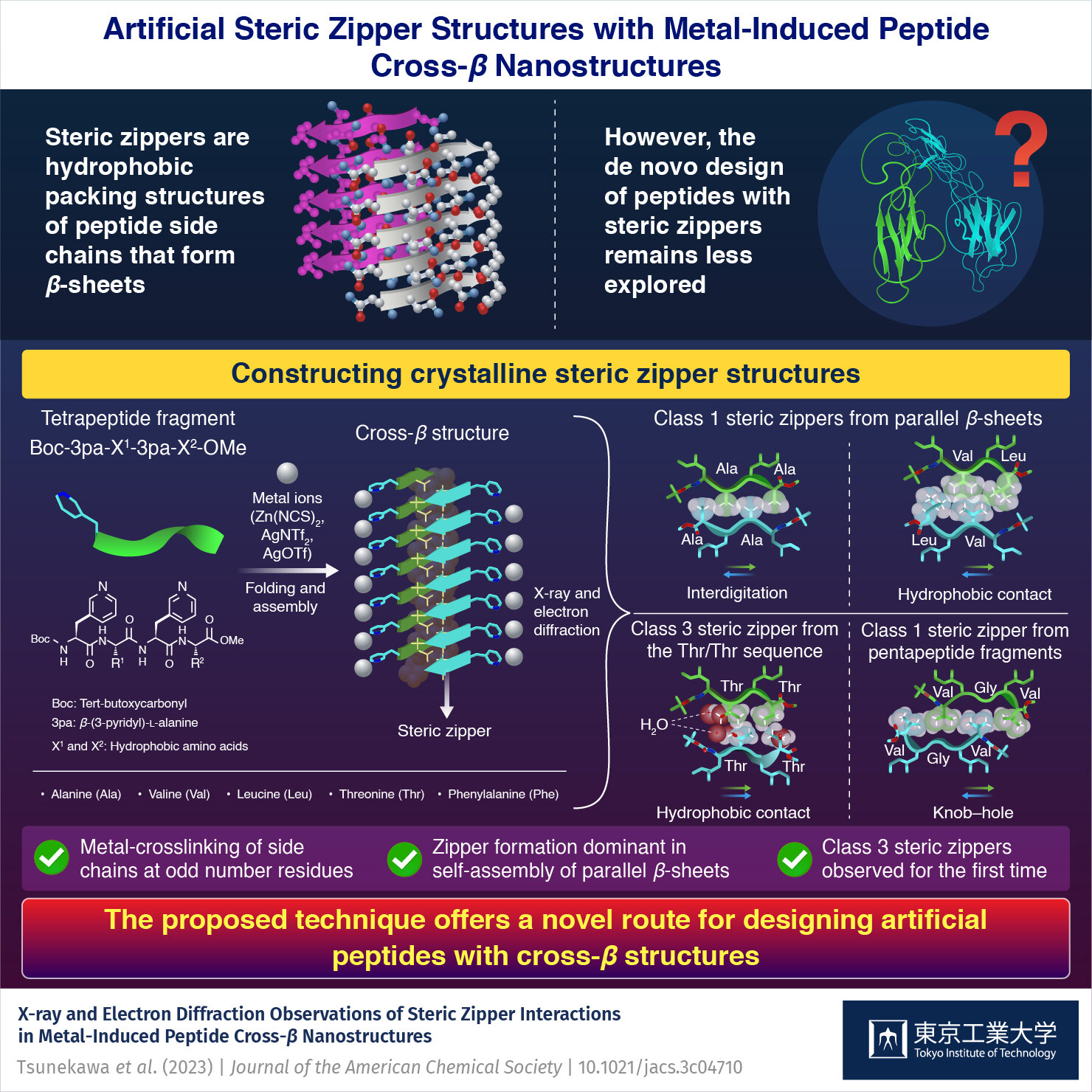
The researchers started by preparing custom Boc-3pa-X1-3pa-X2-OMe tetrapeptide structures. These structures had specific arrangements of hydrophobic amino acids and pyridyl groups on either side of the peptide backbone, which played a crucial role in the formation of steric zippers in the crystalline state.
To prevent uncontrollable aggregation of β-sheet peptides, the researchers introduced the tetrapeptide fragments in microtubes along with metal salts. These salts formed reversible coordination bonds with the pyridyl groups, effectively stopping the aggregation and allowing the formation of needle-shaped crystals containing steric zippers.
By using different combinations of hydrophobic amino acids, the researchers were able to construct various steric zipper structures. They observed that the type of interaction between the β-sheets depended on the size of the alkyl side chains in the hydrophobic amino acids.
Interestingly, the researchers also discovered a new type of steric zipper, known as class 3. These unique structures emerged due to hydrophobic amino acids with side groups other than alkyl groups. This adds to the diversity of steric zipper configurations.
Finally, the researchers expanded their system to a knob-hole-type zipper using pentapeptide fragments. This breakthrough opens up new possibilities for designing artificial peptide materials based on steric zippers.
These findings provide valuable insights into the structural characteristics of steric zippers, which could lead to innovative therapeutic strategies for diseases caused by amyloid fibrils.