Did you know that atomic nuclei are made up of nucleons like protons and neutrons? These particles are held together by a powerful force called the nuclear force. It allows protons and neutrons to form bound states, except when there are only two neutrons involved. In that case, the attractive force is slightly insufficient to create a bound state.
So, here’s an intriguing question: would four neutrons be enough? This question has fascinated atom physicists, who have been actively exploring this mystery both theoretically and experimentally.
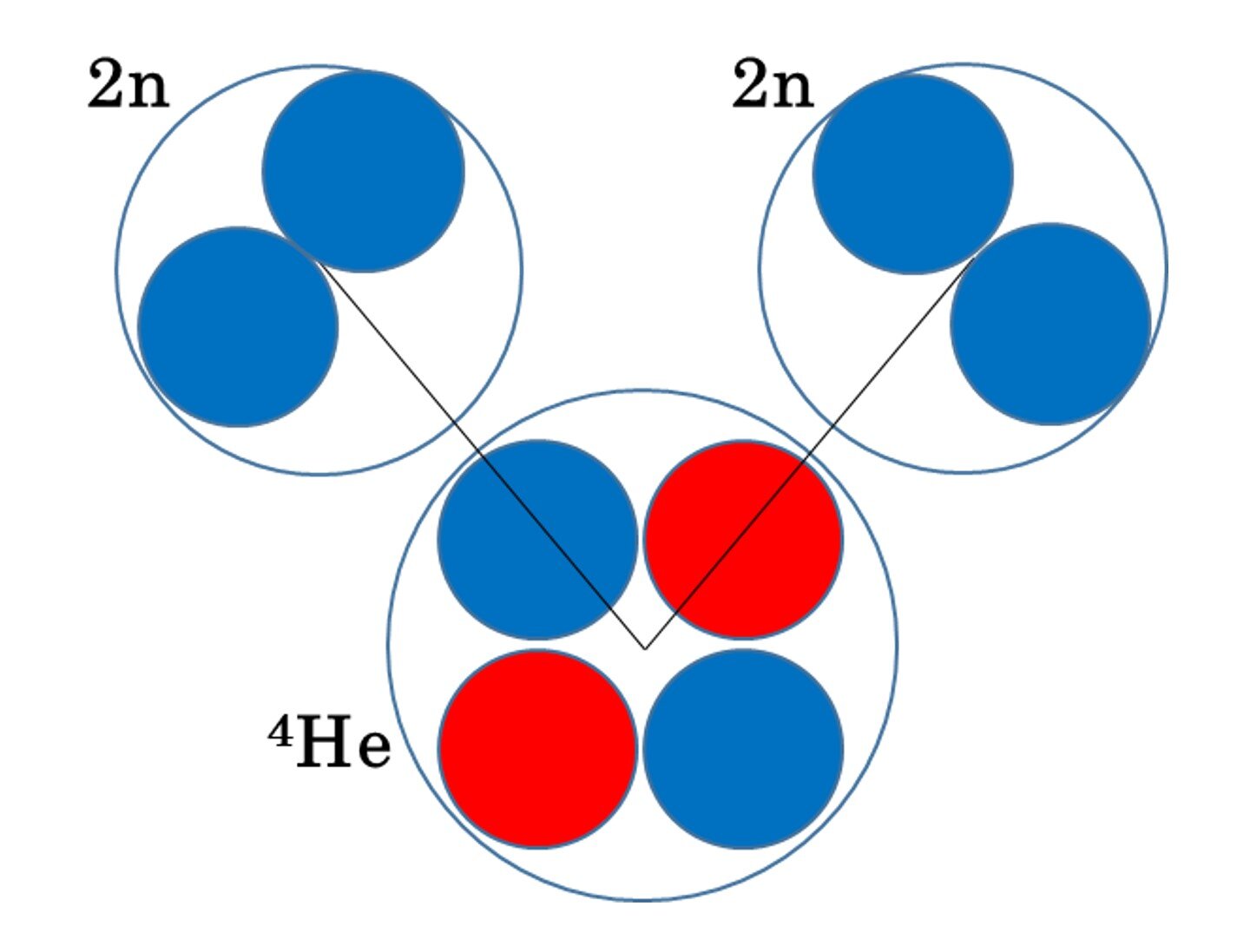
When dealing with weakly bound nuclei, where there is no strong attraction from the center, considering two neutrons as a single unit is crucial for understanding four-neutron correlations.
That’s why a team of researchers led by Associate Professor Wataru Horiuchi and Professor Naoyuki Itagaki from the Osaka Metropolitan University Graduate School of Science focused on the possibility of enhanced correlations between the two neutron pairs that make up the four extra neutrons in the helium isotope 8He (which contains two protons and a total of six neutrons). Their groundbreaking findings were recently published in Physical Review C.
The team conducted extensive calculations using quantum mechanics equations and successfully demonstrated the existence of dineutron-dineutron clusters distributed around the 4He core. They also revealed the arrangement of these clusters.
Professor Horiuchi commented, “Nuclei with an imbalance of protons and neutrons, like 8He, are not naturally found on Earth but are believed to be abundantly generated in cosmic environments, such as stars, through the process of nucleosynthesis. Our results provide new insights into the still largely unknown binding forms of neutrons and deepen our understanding of the origins of the elements around us.”
,,,