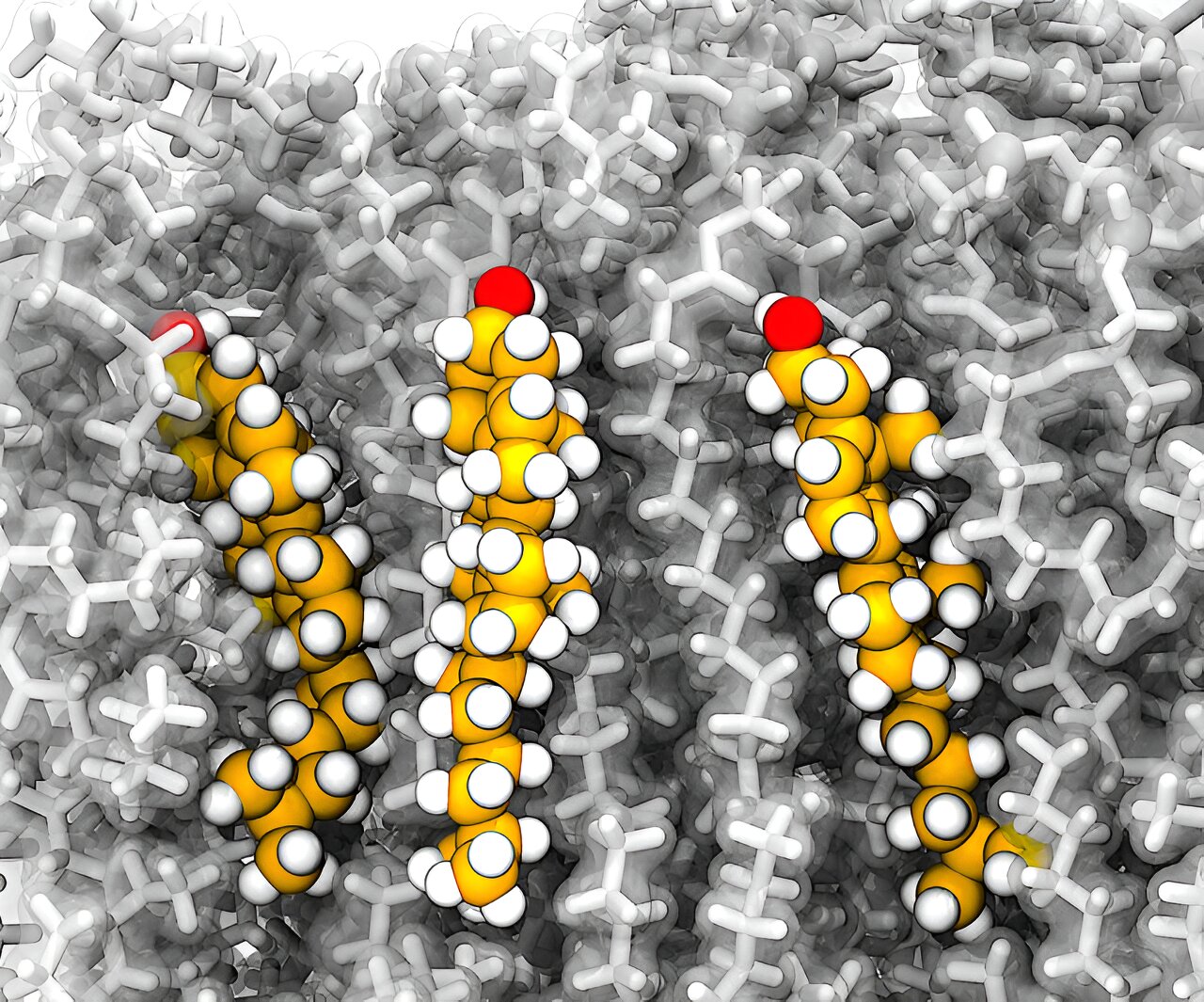
Cholesterol, often seen as a threat to human health, is actually a vital substance that plays numerous critical roles in biology and medicine. It is involved in maintaining membrane fluidity, interacting with lipids and proteins, and facilitating virus-cell interactions. Additionally, cholesterol is a key target for drug development.
Despite its importance, there is still much to learn about cholesterol, particularly how it moves and functions within cellular membranes. Decades of research have provided some understanding, but limitations in studying available sterols and current spectroscopy techniques have hindered progress.
Now, a team of researchers from the University of Illinois Urbana-Champaign and the University of Wisconsin-Madison has made a groundbreaking discovery. They have revealed, for the first time, the atomistic behavior of cholesterol in cells, which could have significant implications for future studies on health and disease.
In a study published in the Journal of the American Chemical Society, biochemistry professor Chad M. Rienstra, along with chemistry professors Martin D. Burke and Taras V. Pogorelov, describe how they combined advanced experimental and computational methods to capture the movement of cholesterol molecules in cell membranes.
“This work demonstrates the power of combining new experimental and computational techniques to enhance our understanding of membranous cholesterol dynamics,” said Pogorelov.
Their approach involved state-of-the-art experiments, molecular dynamics simulations, and quantum mechanical calculations. By labeling each carbon atom and investigating their motion and forces, the researchers gained insights into how cholesterol moves within membranes.
They discovered that cholesterol exhibits segmental dynamic coupling between its fused rings and tail conformations. The movements of the tail and the entire molecule are correlated, with the tails rotating in a “crankshaft manner.”
The researchers also identified and quantified specific cholesterol conformations in membranes, thanks to their integrated experimental-computational workflow.
These findings have broad implications for understanding the function of sterols in living systems. The methods developed in this study open new avenues for investigating how cholesterol influences the dynamics of membrane proteins in both health and disease.