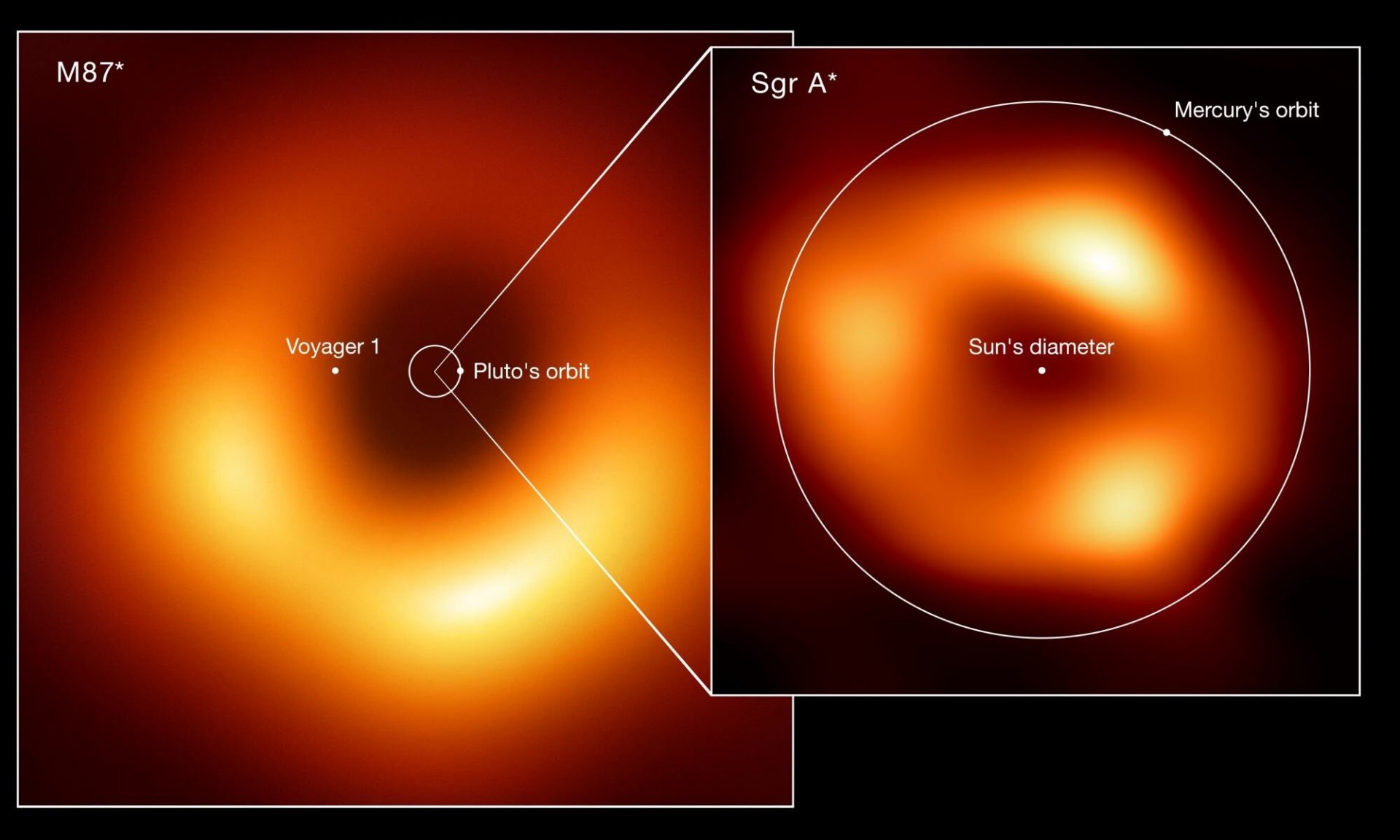
Deep within our galaxy lies a colossal black hole, known as Sagittarius A*. With a mass equivalent to 4.2 million suns, it resides a mere 27,000 light-years away from Earth. Sag A* is not only the closest supermassive black hole to us, but also one of the only two that we have directly observed. Its proximity allows us to witness stars orbiting it, some of which we have been studying for over two decades. Through these observations, we have accurately determined the mass of Sag A*. However, a new study seeks to answer a different question: does our galaxy’s black hole have a companion?
Most galaxies harbor a supermassive black hole, and some even possess two. This occurs when one galaxy captures the black hole of another during a galactic merger. However, our observations indicate that our galaxy does not have two supermassive black holes. It is possible that there are stellar mass black holes orbiting Sag A*, but our current observations lack the sensitivity to detect them. Another intriguing possibility is the presence of an intermediate black hole orbiting Sag A*, which is the focus of this study.
An intermediate mass black hole (IMBH) falls within the mass range of hundreds to thousands of suns. They do not form from the collapse of massive stars, nor are they the gravitational seeds of galaxies. The discovery of IMBHs is relatively recent, made possible through the detection of gravitational waves from black hole mergers. Consequently, our understanding of IMBHs is limited, and their prevalence remains unknown. However, if an IMBH orbits Sag A*, its gravitational pull would influence the orbits of nearby stars that also revolve around our supermassive black hole.
In this study, available on the preprint server arXiv, the research team examined the orbit of a star called S0-2, or S2 for short. S2 boasts one of the closest orbits to Sag A*, completing a full revolution in just 16 years. Its proximity to the black hole necessitates the incorporation of general relativity when calculating its orbit, and we have over two decades of observational data on this star. If there is an IMBH in the vicinity, S0-2 should be affected by its presence.
The team’s findings indicate that, within the limits of observation, there is no evidence of gravitational disturbances in the orbit of S0-2. This does not definitively rule out the existence of an intermediate-mass black hole in the area, but it does provide upper limits on its mass if it does indeed exist. Based on the data, if a hypothetical IMBH orbits beyond the orbit of S0-2, with an orbital radius ranging from 1,000 AU to 4,000 AU, its mass cannot exceed 1,000 to 10,000 suns. If there is an IMBH orbiting Sag A* closer than S0-2, then its mass cannot exceed 400 suns.
While these constraints are not overly restrictive, they do confirm that there is no significant intermediate black hole orbiting Sagittarius A*. If it does have a smaller IMBH companion, our current detection capabilities are insufficient to identify it.