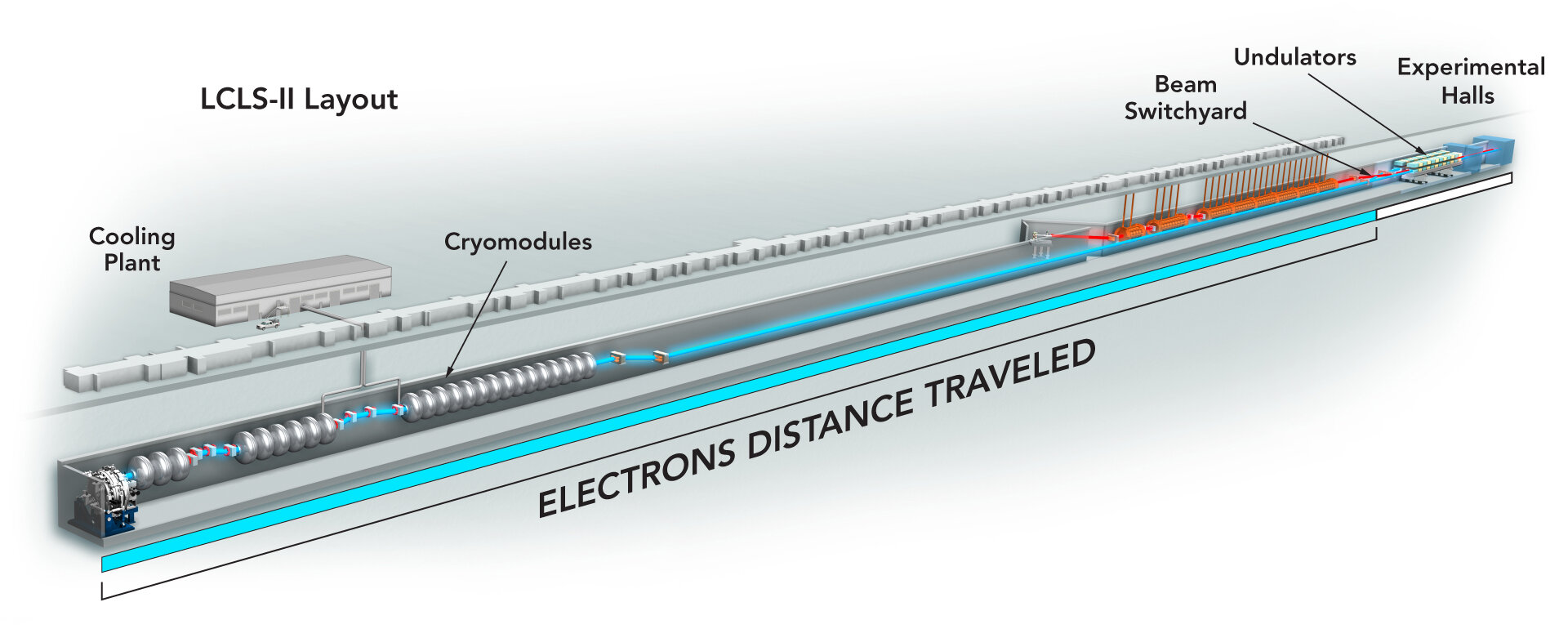
Get ready for a groundbreaking era in scientific research! After more than a decade of hard work, electrons are now soaring through the new superconducting accelerator at the Department of Energy’s SLAC National Accelerator Laboratory. This incredible project, known as the Linac Coherent Light Source II (LCLS-II), is just steps away from unleashing X-ray flashes that will revolutionize atomic-level studies.
“Seeing electrons make it all the way through the LCLS-II is proof that our idea to make the source for an extremely powerful superconducting X-ray machine at SLAC is going to work,” says Dan Gonnella, lead scientist at SLAC. “We were confident in our work, but until you see the first electrons actually make it through, you are feeling the butterflies.”
To achieve this milestone, teams from four national laboratories—Argonne, Berkeley Lab, Fermilab, and Jefferson Lab—and Cornell University collaborated for nearly 10 years to build the facility’s next-generation components.
In 2019, a state-of-the-art electron gun was installed, and earlier this year, a helium cooling plant was activated, bringing the facility’s temperature down to two kelvins—colder than outer space.
LCLS-II will produce X-rays that are 10,000 times brighter than those of SLAC’s existing free-electron laser facility, LCLS. This upgrade will provide unprecedented insights into pressing scientific questions, such as developing clean fuels, sustainable manufacturing methods, and new drugs.
“We are not answering only a few questions with the new superconducting accelerator, we are letting scientists answer an incredible number of questions,” says SLAC electronics engineering manager Andy Benwell.
Niobium helps electrons fly
LCLS-II’s extremely cold operating temperature allows it to run efficiently and conduct electricity with almost zero resistance. To achieve this, specific materials like niobium, a rare earth metal, are used in the accelerator’s construction.
A string of bright niobium cavities inside LCLS-II accelerates electrons, with each cryomodule containing eight cavities. In total, LCLS-II has almost 300 cavities, enough to stretch the length of about three soccer fields.
These niobium cavities propel the electrons towards the undulator hall, where they pass through precisely tuned magnets, emitting X-rays. These X-rays are then used for experiments.
The cavities enable LCLS-II to deliver an unprecedented stream of pulses, allowing researchers to capture detailed movies of atomic-sized processes in nature.
Avoiding dust for a decade
Dust is the enemy of accelerator performance. Even the tiniest particles can disrupt the superconducting cavities and produce unwanted X-rays. To combat this, meticulous care was taken during the assembly process.
“The people who worked tirelessly on the superconducting accelerator did a phenomenal job,” says John Schmerge, director of SLAC’s Accelerator Directorate. “They made every effort to produce a clean, world-class machine.”
The path to first light
While electrons are now flowing through the accelerator, there is still work to be done before X-rays are generated. The team will focus on improving the quality of the electron beam to ensure successful experiments.
“If you have a nice tight electron beam, you get better X-ray production,” explains Schmerge. “Whereas if the electron beam is spread out, you don’t get very many photons at the end of the tunnel.”
Despite the remaining tasks, the team feels a significant sense of accomplishment. “Producing a high-energy electron beam gives us a sense that everything is working as we had hoped for,” says SLAC scientist Axel Brachman.
Why electrons?
SLAC’s superconducting particle accelerator uses electrons to generate X-rays. The choice of electrons is due to their lighter weight, making them easier to accelerate to near light-speed. Additionally, electrons are easier to produce and manipulate for X-ray laser experiments.