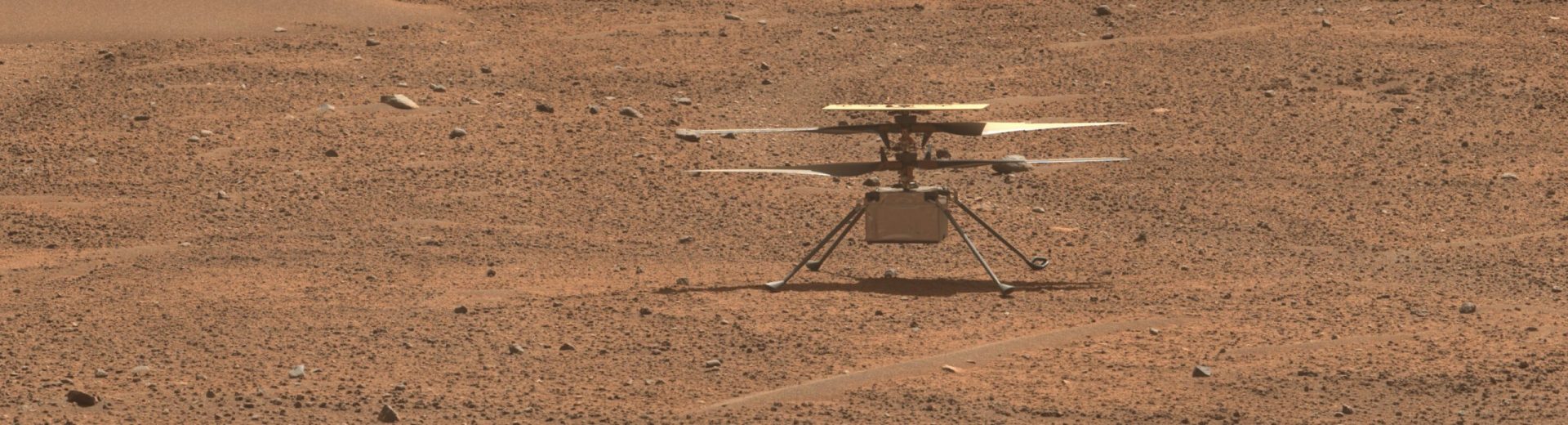
Exciting news from NASA’s Ingenuity Mars Helicopter! On August 3rd, it completed its 54th flight, marking its return to the skies after a shortened flight on July 22nd. This 25-second hop provided valuable data that could help the Ingenuity team understand why its 53rd flight ended prematurely.
Flight 53 was originally planned as a 136-second scouting mission to capture images of the Martian surface for the Perseverance Mars rover science team. The flight involved flying north for 666 feet at an altitude of 16 feet and a speed of 5.6 mph. It would then descend vertically to 8 feet, hover, and capture imagery of a rocky outcrop. After that, Ingenuity would climb to 33 feet, allowing its hazard divert system to activate before descending vertically for a landing.
However, during Flight 53, the helicopter encountered an unexpected scenario. It completed the first half of its autonomous journey, flying north at an altitude of 16 feet for 466 feet. Then, a flight-contingency program was triggered, and Ingenuity safely landed. The entire flight lasted 74 seconds.
Teddy Tzanetos, team lead emeritus for Ingenuity at NASA’s Jet Propulsion Laboratory, explained, “Since the very first flight, we have included a program called ‘LAND_NOW’ to ensure the helicopter lands as soon as possible in case of any off-nominal scenarios. During Flight 53, we encountered one of these scenarios, and the helicopter executed an immediate landing as planned.”
The Ingenuity team believes that the early landing was triggered by a synchronization issue between the helicopter’s navigation camera and its inertial measurement unit. This unit measures Ingenuity’s acceleration and rotational rates, providing crucial data for its positioning and orientation in space.
This isn’t the first time the helicopter’s navigation camera has dropped image frames during a flight. A similar incident occurred on May 22, 2021, resulting in some instability towards the end of Flight 6. After that, the team updated the flight software to mitigate the impact of dropped images, which worked well for the following 46 flights. However, on Flight 53, the number of dropped navigation images exceeded the software’s patch limit.
Tzanetos added, “While we had hoped to avoid triggering a LAND_NOW scenario, Flight 53 serves as a valuable case study that will benefit future aircraft missions on other planets. The team is diligently investigating what happened during this flight, and with the success of Flight 54, we are confident that our little Ingenuity is ready to continue soaring ahead on Mars.”