For over two decades, Li-Qun “Andrew” Gu at the University of Missouri has been passionately solving life science problems by creating sophisticated diagnostic tools at the nanoscale.
Recently, Gu, a professor in the Chemical and Biomedical Engineering Department and investigator in the Dalton Cardiovascular Research Center, along with a team of researchers, developed a groundbreaking method using nanopores—a nanometer-sized hole—to advance discoveries in neuroscience and other medical applications. To put it into perspective, the thickness of a single sheet of paper is about 100,000 nanometers.
“This new technique has the potential to revolutionize the study of DNA- and RNA-based diseases and disorders, such as COVID-19, HIV, and certain types of cancers. It allows us to observe how drug therapies work and even discover new small-molecule drug compounds for future treatments,” said Gu. “Additionally, this tool could aid in the development of sensors for neurotransmitters, enabling studies in neurochemistry and neurodegenerative disease diagnostics.”
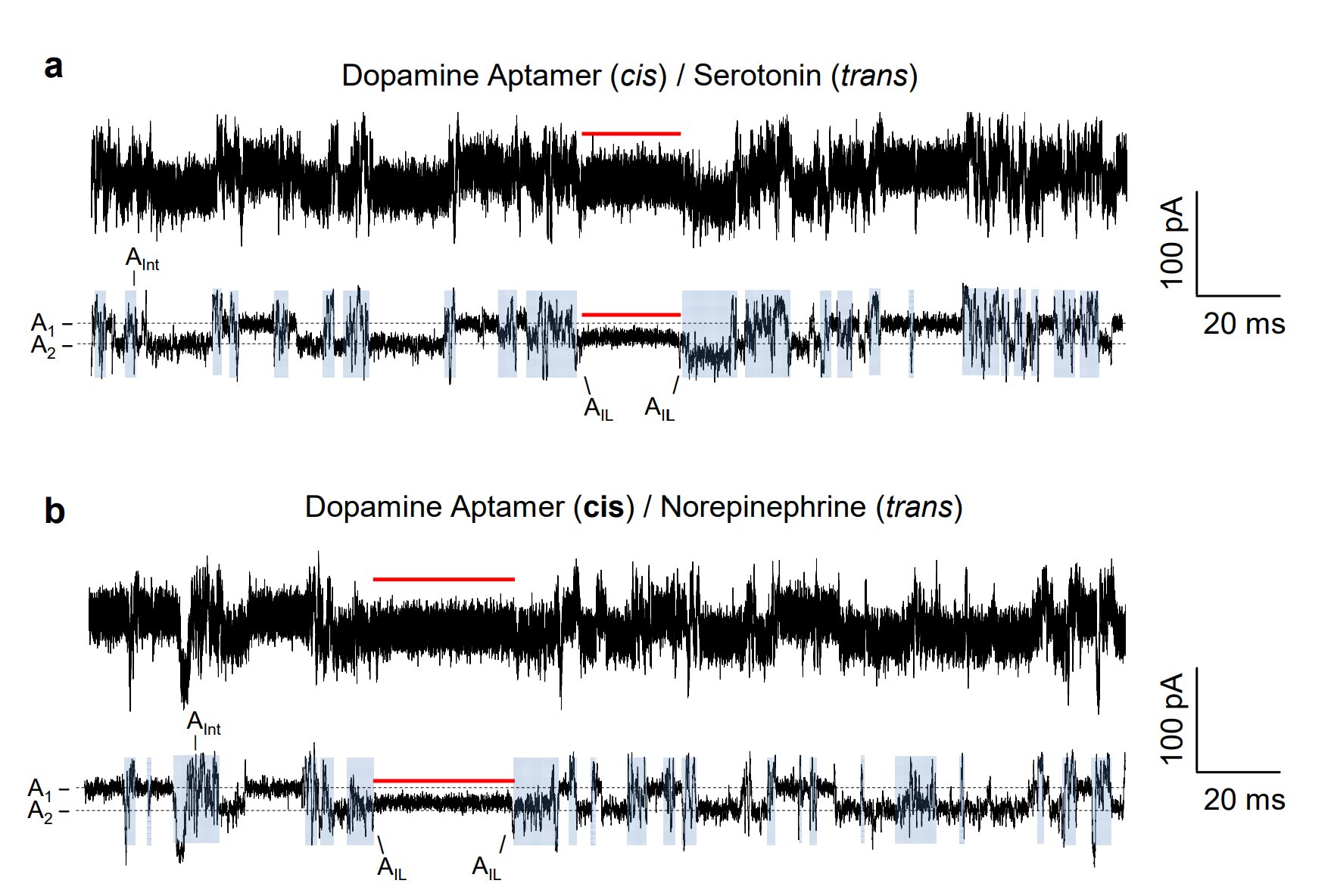
The technique involves aptamers, which are single strands of DNA or RNA molecules that selectively bind to specific targets. This enables researchers to precisely detect and study the interactions between individual molecules using the nanopores, explained Kevin Gillis, a co-corresponding author on the study.
Gillis, who is a professor and chair of the Chemical and Biomedical Engineering Department and investigator in the Dalton Cardiovascular Research Center, highlighted that the interaction between single molecules is detected through tiny ion currents passing through a nanopore.
“Nanopores act as built-in amplifiers, as the binding of a single molecule can block the flow of millions of ions through the pore. This disruption in current allows us to observe the movement or binding of single molecules inside the nanopores,” he said.
Gillis expressed his admiration for innovative researchers like Gu, who continue to find new ways to utilize nanopores in understanding small-molecule molecular interactions with single-molecule precision.
“This approach contributes to the field of synthetic biology, which aims to replicate the most important features of life by recreating basic biological functions synthetically. It is one of the most powerful approaches to understanding the fundamental principles of life,” Gillis added.
The study titled “Real-time label-free detection of dynamic aptamer–small molecule interactions using a nanopore nucleic acid conformational sensor” was published in the Proceedings of the National Academy of Sciences.